Baku is the capital of Azerbaijan, on the Caspian Sea in the South Caucasus, and it sits in one of the genuinely ambiguous parts of the world map. Whether it is in Europe or Asia depends on which convention you apply.
Where does the boundary fall?
The most widely used convention runs the divide along the Greater Caucasus watershed, which places most of Azerbaijan, including Baku, in Asia. Other conventions run it further south along the Aras river, which would place the country in Europe.
There is no single authority, which is why sources disagree.
Why does it appear on European lists?
Because Azerbaijan is a member of the Council of Europe and competes in UEFA football and the Eurovision Song Contest, which it hosted. Institutionally it is treated as European even where it is geographically placed in Asia.
What is the city like?
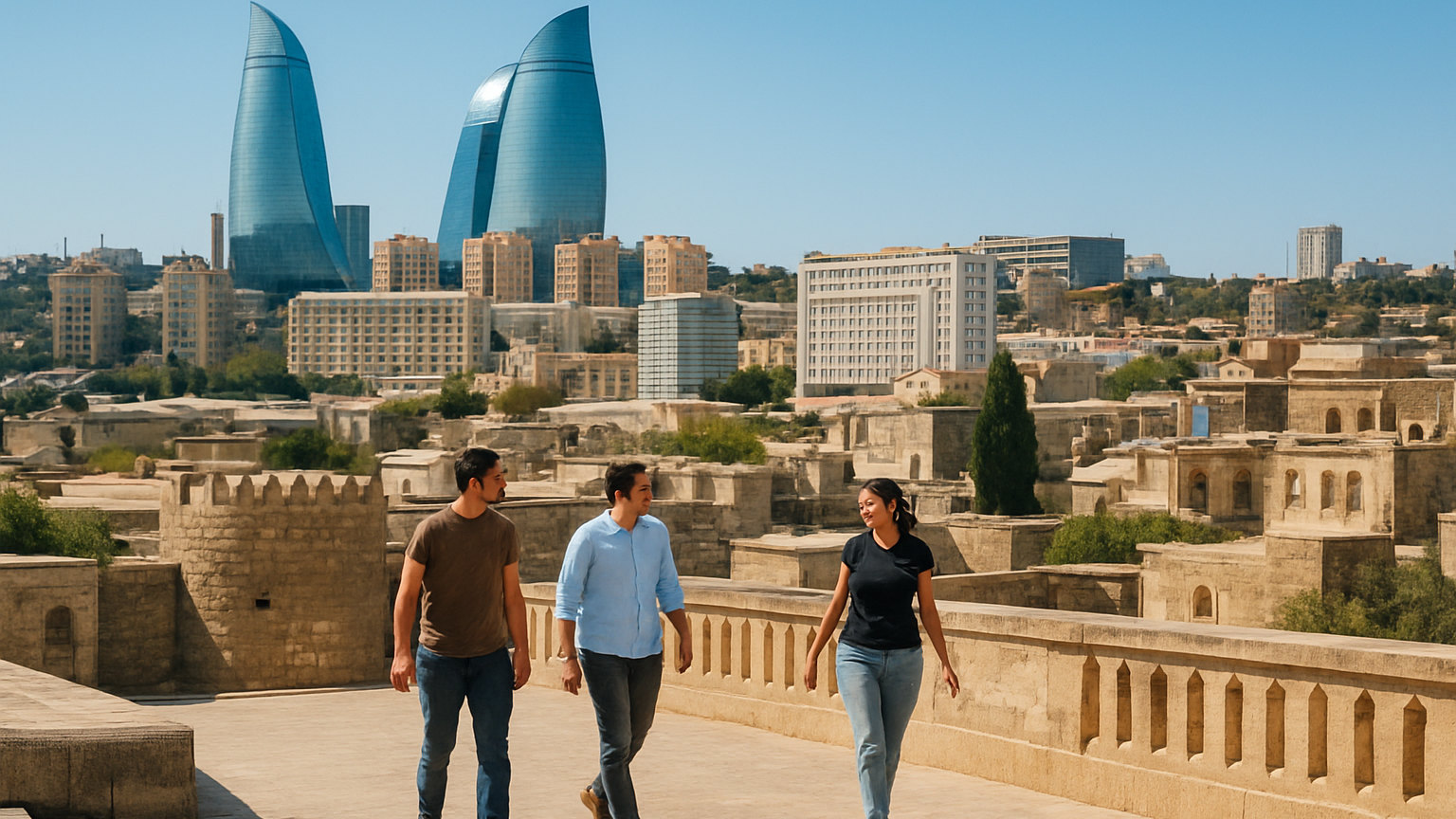
A striking mix. A walled medieval old city, a belle epoque centre built on the first oil boom, and a skyline of contemporary towers from the second. The seafront promenade runs for kilometres along the Caspian.
What should you see?
Icherisheher, the walled old city, with the Maiden Tower and the Palace of the Shirvanshahs. The Flame Towers, three curved skyscrapers lit at night. The Heydar Aliyev Centre, a Zaha Hadid building of flowing white curves. The boulevard.
What is outside the city?
Gobustan, with thousands of prehistoric rock carvings and a landscape of mud volcanoes, around an hour away. The fire temple at Ateshgah and the burning hillside at Yanar Dag, both connected to the natural gas that runs beneath the region.
How expensive is it?
Moderate and cheaper than western Europe. Food and transport are inexpensive; hotels in the centre are priced for business and event visitors.
Is it safe?
Baku is generally safe for visitors with ordinary precautions. Regional political tensions affect specific border areas rather than the capital, and current government travel advice should be checked before travelling.
When should you go?
April to June and September to October. Summer is hot and humid on the Caspian, and the winter wind that gives the city its name as a place of winds is persistent.
How do you get there?
Direct flights from some European cities and connections via Istanbul or the Gulf. Entry requirements including any visa arrangements should be checked in advance.
How long do you need?
Three nights: two for the city and one for Gobustan and the fire sites. It combines well with Georgia, which is a short flight or an overnight train away.
What is the old city like?
A compact walled quarter of narrow lanes, caravanserais and carpet shops, protected as a world heritage site and considerably quieter than the modern centre around it. It takes a morning and is the most atmospheric part of Baku.
What about the language?
Azerbaijani, with Russian widely spoken and English increasingly common in the centre. Signage in tourist areas is frequently in English, and the city is straightforward to navigate.
How long is the flight?
Around six hours direct from western Europe where services run, and longer via Istanbul or the Gulf. The time difference is several hours ahead of the UK, which is worth allowing for on a short trip.
What is the currency?
The manat. Cards are widely accepted in the centre, and cash is useful in the old city and for taxis outside the main areas.
Why is it called the city of winds?
Because of the persistent northerly that blows off the Caspian, particularly in winter. It is strong enough to be a defining local feature and is the origin of the name, and it makes the seafront considerably colder than the temperature suggests.
See also What Is Yerevan Like to Visit?, which covers a related part of the same decision, and our other Destinations guides.
The short answer
Geographically Baku is usually placed in Asia, south of the Caucasus watershed, while Azerbaijan is treated as European institutionally through the Council of Europe, UEFA and Eurovision. Allow three nights for the old city, the Flame Towers and Gobustan.