
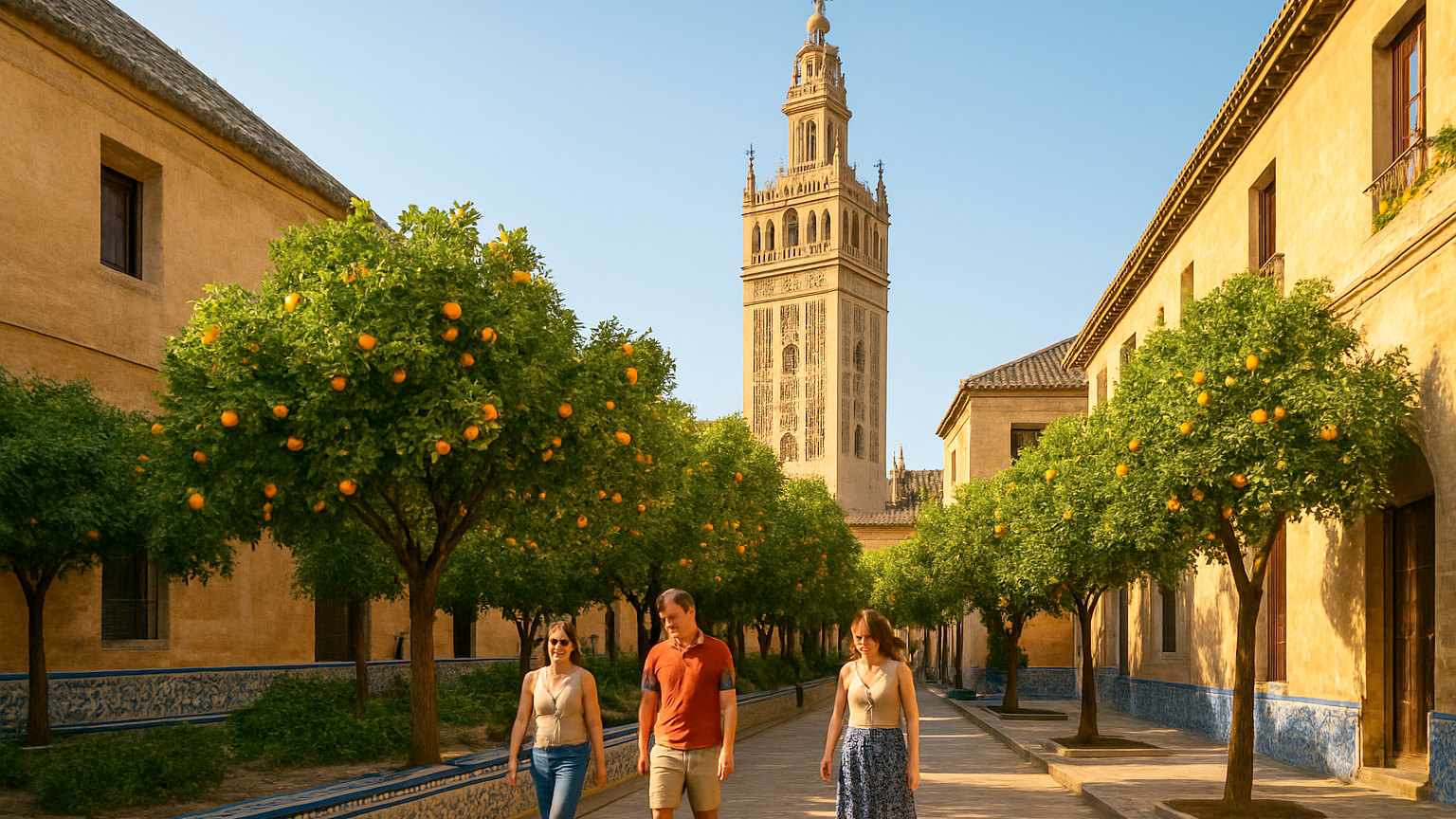
Seville has the finest Moorish palace still in use in Europe, the largest Gothic cathedral in the world and a temperature in July and August that regularly exceeds forty degrees. Those three facts between them determine almost everything about planning a trip here.
How long do you need?
Three nights. Two full days covers the Alcazar, the cathedral and the main barrios comfortably. A third day allows Italica, Cordoba or simply a slower pace, which suits the city.
What are the essential sights?
The Real Alcazar, a royal palace begun under Moorish rule and extended for centuries, with tilework, courtyards and gardens that are the best single building in Spain. The cathedral and the Giralda bell tower, a converted minaret climbed by ramps rather than stairs. The Plaza de Espana, a vast semicircular pavilion from the 1929 exposition. The Metropol Parasol for the view.
What should you book ahead?
The Alcazar, which uses timed entry and sells out days in advance in spring and autumn. The cathedral and Giralda combined ticket is worth booking in season. Everything else can be decided on the day.
Which neighbourhoods should you see?
Santa Cruz, the former Jewish quarter beside the Alcazar, a maze of whitewashed lanes and orange trees, which is beautiful and heavily touristed. Triana across the river, the traditional home of flamenco and ceramics, which is where the city feels most itself. Alameda for a younger, cheaper night out. Macarena to the north for the basilica and fewer visitors.
Where should you see flamenco?
Seville is the centre of it and the quality varies enormously. The large dinner shows aimed at coach parties are the weakest. Smaller venues such as Casa de la Memoria and La Carboneria, and the peñas in Triana, offer something far closer to the real thing. Book the small venues, since they hold fifty people rather than five hundred.
When is the best time to visit?
March to May and October to November. Seville in July and August is among the hottest cities in Europe and sightseeing in the middle of the day becomes genuinely unwise. Winter is mild at around sixteen degrees and is an excellent and underused time to visit. Semana Santa and the Feria de Abril in spring are extraordinary and fill every hotel at triple the usual rate.
How does eating work?
Late, as everywhere in Spain, with dinner after nine. Tapas here are ordered and paid for, and the tradition is to have one or two at each bar and move on rather than settling in. Triana and the streets around the Alameda are better than Santa Cruz, where the prices reflect the postcode.
What is worth a day trip?
Cordoba, forty-five minutes by fast train, for the Mezquita, which is among the most remarkable buildings in Europe. Italica, a Roman city on the edge of the city with well-preserved mosaics. Jerez for sherry and horses.
What do people get wrong?
Booking August because it is the school holiday, then finding the useful day runs from eight until noon and resumes at seven. The second is not booking the Alcazar, which means either a long queue or no entry at all.
How much should you budget?
Seville is cheaper than Madrid or Barcelona and among the better value cities in western Europe. Accommodation in Triana or the Alameda costs less than Santa Cruz for a ten-minute walk. Tapas bars are inexpensive if you stand at the bar rather than take a table, where a surcharge often applies.
How do you get around?
On foot, since the centre is compact and largely pedestrianised. The city has an excellent and cheap bicycle hire scheme and flat terrain. The tram covers the short central route and the metro is of little use to visitors.
Athens City Guide: Acropolis, Markets and Beyond goes into more detail on a closely related question, and the rest of our Destinations section covers the wider subject.
The short answer
Three nights, ideally in April, May or October. Book the Alcazar before you travel and go first thing, climb the Giralda, cross to Triana for the evening, see flamenco in a small venue, and avoid the city entirely in high summer.


