
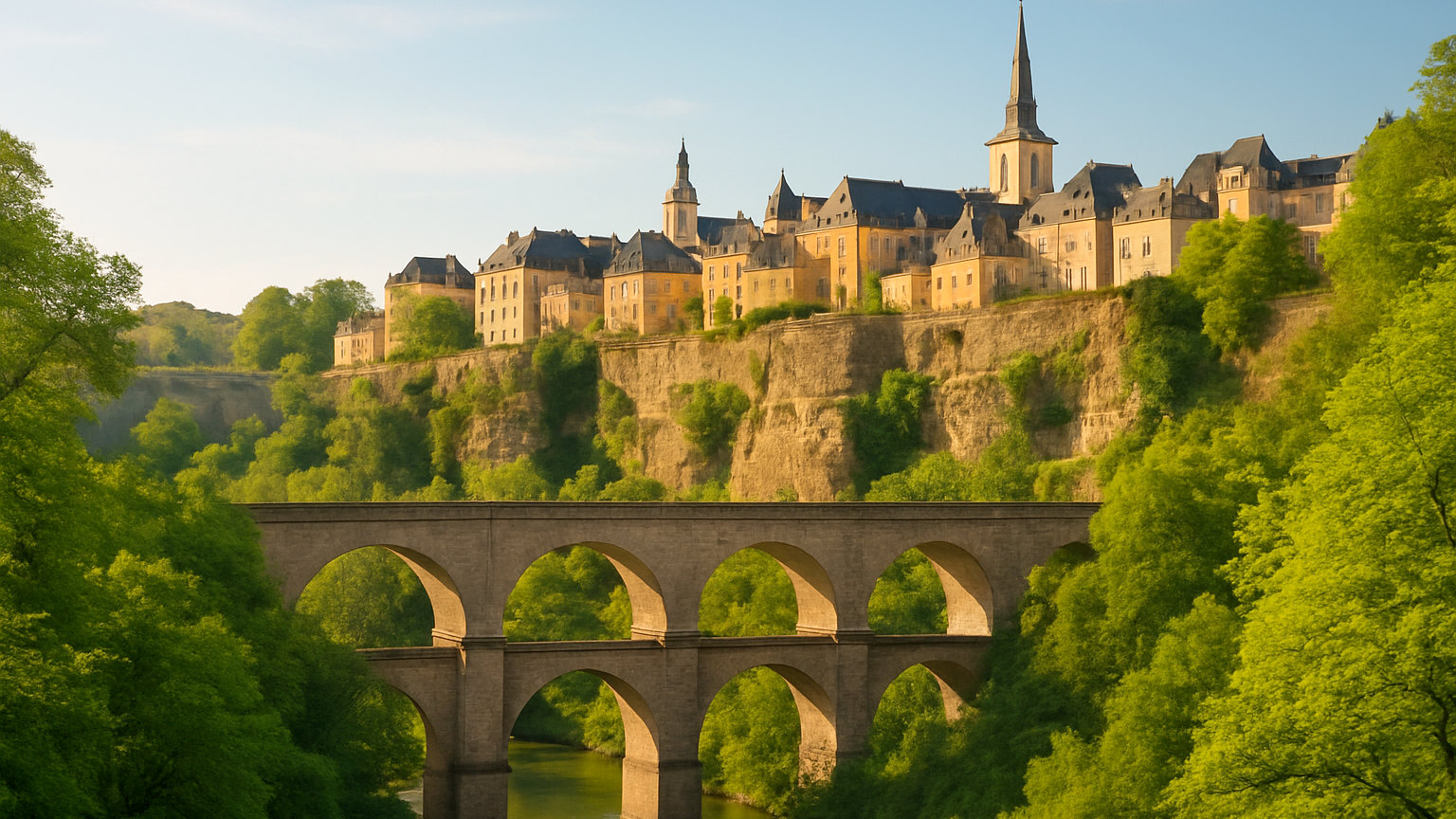
Luxembourg is the third smallest country in the European Union and is almost always treated as a stopover. The capital is built across a deep gorge with fortifications carved into the rock, the north is castle country, and the whole of public transport in the country is free to everyone, which is unique in Europe.
How long does Luxembourg City need?
Two nights. The old town sits on a clifftop with the Grund district in the ravine below, connected by lifts and steep paths, and the Bock casemates are tunnels cut through the rock beneath the former fortress. The walk along the Corniche is often called the most beautiful balcony in Europe and earns it. The modern Kirchberg quarter, full of EU institutions, is the other half of the city and worth an hour.
Is the transport really free?
Yes. Trains, trams and buses across the entire country carry no fare for anyone, resident or visitor, in second class. First class on trains still requires a ticket. This makes Luxembourg unusually cheap to explore and removes any argument for hiring a car for a short trip.
What is the Mullerthal?
A region of sandstone rock formations, narrow chasms and beech woodland in the east, marketed as Little Switzerland, which overstates it while still being genuinely good walking. The Mullerthal Trail runs for over a hundred kilometres in three loops and Echternach, the oldest town in the country, is the base.
Which castles are worth seeing?
Vianden, in the north, is the set piece: a restored hilltop castle above a river town, reached by chairlift if you want the view. Bourscheid is a ruin on a spur in a loop of the Sure. Beaufort has a Renaissance house beside a medieval ruin. All three are reachable by the free buses, if slowly.
Is the Moselle worth a day?
The southeastern border with Germany runs along the Moselle, terraced with vineyards producing Riesling and cremant. Remich and Grevenmacher are the main towns, boat trips run in summer, and the cellars offer tastings. It is a relaxed half or full day from the capital.
What about the war history?
The north of the country was fought over during the Battle of the Bulge. The Luxembourg American Cemetery near the capital holds over five thousand graves including that of General Patton, and the museum at Diekirch covers the campaign in detail.
Is Luxembourg expensive?
Accommodation and restaurants are expensive, in line with Belgium and above Germany, and the free transport offsets part of that. Hotel rates fall sharply at weekends, when the business travellers leave, which is the opposite of most European cities and is worth using.
When is the best time to visit?
May to September for the walking, the river and the long evenings. December for the Christmas market in the capital, which is small and pleasant. The weather is similar to Belgium and unreliable in any month.
How does it combine with neighbours?
Easily. Trier in Germany is fifty minutes by train, Brussels is three hours and Metz in France is an hour. Luxembourg works well as a two-night stop within a wider trip rather than as a week on its own.
What do people get wrong?
Treating it purely as a stopover and seeing only the Kirchberg business district near the station, which is the least interesting part of the city. The gorge, the Grund and the Corniche are a twenty-minute walk away and are what make the place worth stopping for at all.
How long do you need?
Two nights for the capital, or four if you want Vianden, the Mullerthal and the Moselle as well. The free transport makes the longer version cost very little more.
Is Monaco Worth Visiting? What to See and Do goes into more detail on a closely related question, and the rest of our Destinations section covers the wider subject.
The short answer
Two nights in the capital for the gorge and the casemates, a day at Vianden and a day in the Mullerthal, all of it on free transport. Book at a weekend for lower hotel rates, and combine it with Trier or Brussels.


