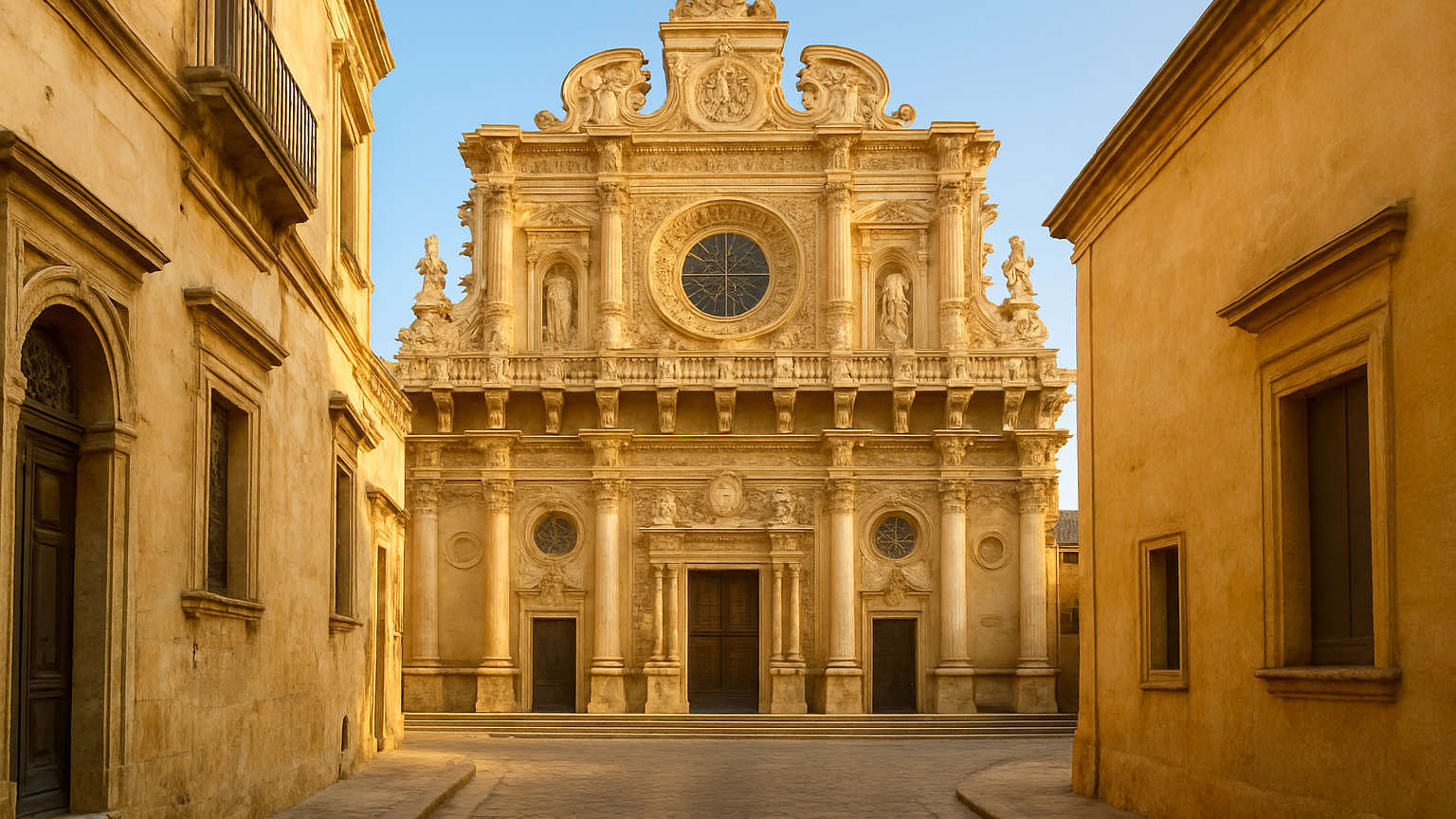
Lecce sits near the tip of the Italian heel, in the Salento region of Puglia. The local limestone is soft enough to be carved almost like wood and hardens on exposure to air, and seventeenth-century stonemasons took full advantage. The result is an old town of baroque facades so densely decorated that the style is named after the city.
What makes it different?
Scale and colour. Lecce is not a large city, and the entire historic centre is built from the same warm honey-coloured stone, which turns gold in late afternoon light. Unlike the baroque of Rome or Turin, this is concentrated into a walkable few streets, and unlike Sicily it sits within easy reach of two coastlines.
How long do you need?
Two nights for the city, or a week using it as a base for the Salento. The old town is small enough to see in a day and the surrounding region has beaches on both the Adriatic and the Ionian within forty minutes.
What should you see?
The Basilica di Santa Croce, whose facade is the most elaborate in the city and took over a century to complete. Piazza del Duomo, an enclosed square entered through a single gateway, which is unusual and works beautifully at night when it is lit. The Roman amphitheatre, half excavated in the middle of the main square. The Castello Carlo V. The papier mache workshops, which are a local craft tradition.
Where are the beaches?
Both coasts are close. The Adriatic side around Otranto and Torre dell Orso has cliffs and clear water. The Ionian side around Gallipoli and Porto Cesareo has shallow sandy beaches and warmer, calmer water, which suits families. Punta Prosciutto and the Maldive del Salento have the best sand in the region. All need a car.
Where should you stay?
Inside the old town, in one of the converted palazzi, which is the point of coming. The area around Porta Napoli is central and slightly cheaper. Masserie, fortified farmhouses converted into hotels, are scattered through the countryside and are the alternative if you want a pool and a car.
Where should you eat?
Puglian cooking is vegetable-led and cheap. Orecchiette with turnip tops, burrata from nearby Andria, ciceri e tria with fried pasta, and the rustico leccese, a pastry with mozzarella and tomato eaten standing. The pasticciotto, a small custard tart, is the local breakfast. Primitivo and Negroamaro are the regional wines.
How do you get there?
Brindisi airport is around forty minutes away and Bari around ninety, both with direct flights from the UK in season. Trains run from Bari in under two hours. A car is necessary for the beaches and the smaller towns, and unnecessary within Lecce itself.
When is the best time to visit?
May, June, September and early October. July and August are very hot and the Salento fills with Italian holidaymakers, which makes the beaches busy and the prices rise. Winter is mild and the city is empty, and the baroque looks better in low sun.
How much should you budget?
Among the better value parts of Italy. Accommodation, restaurants and wine all cost noticeably less than Tuscany or the Amalfi Coast, and the beaches are largely free or cheaply organised.
What is worth a day trip?
Otranto, the easternmost town in Italy, with a castle and a cathedral floor covered in a twelfth-century mosaic. Gallipoli, an island old town joined to the mainland by a bridge. Ostuni, the white town, an hour north. Alberobello and the trulli, around ninety minutes.
What do people get wrong?
Visiting in August, when the Salento is at its hottest and busiest and the roads to the coast are slow. The second is trying to see Puglia without a car, which leaves you in the towns on the rail line and nowhere near the beaches.
If you are planning further, Ghent: The Belgian City to Visit Instead of Bruges covers the next part of the decision, and there is more in our Destinations guides.
The short answer
Two nights in the old town, or a week with a car using Lecce and a masseria. See Santa Croce and Piazza del Duomo at dusk, eat a pasticciotto for breakfast, and split beach days between the two coasts.