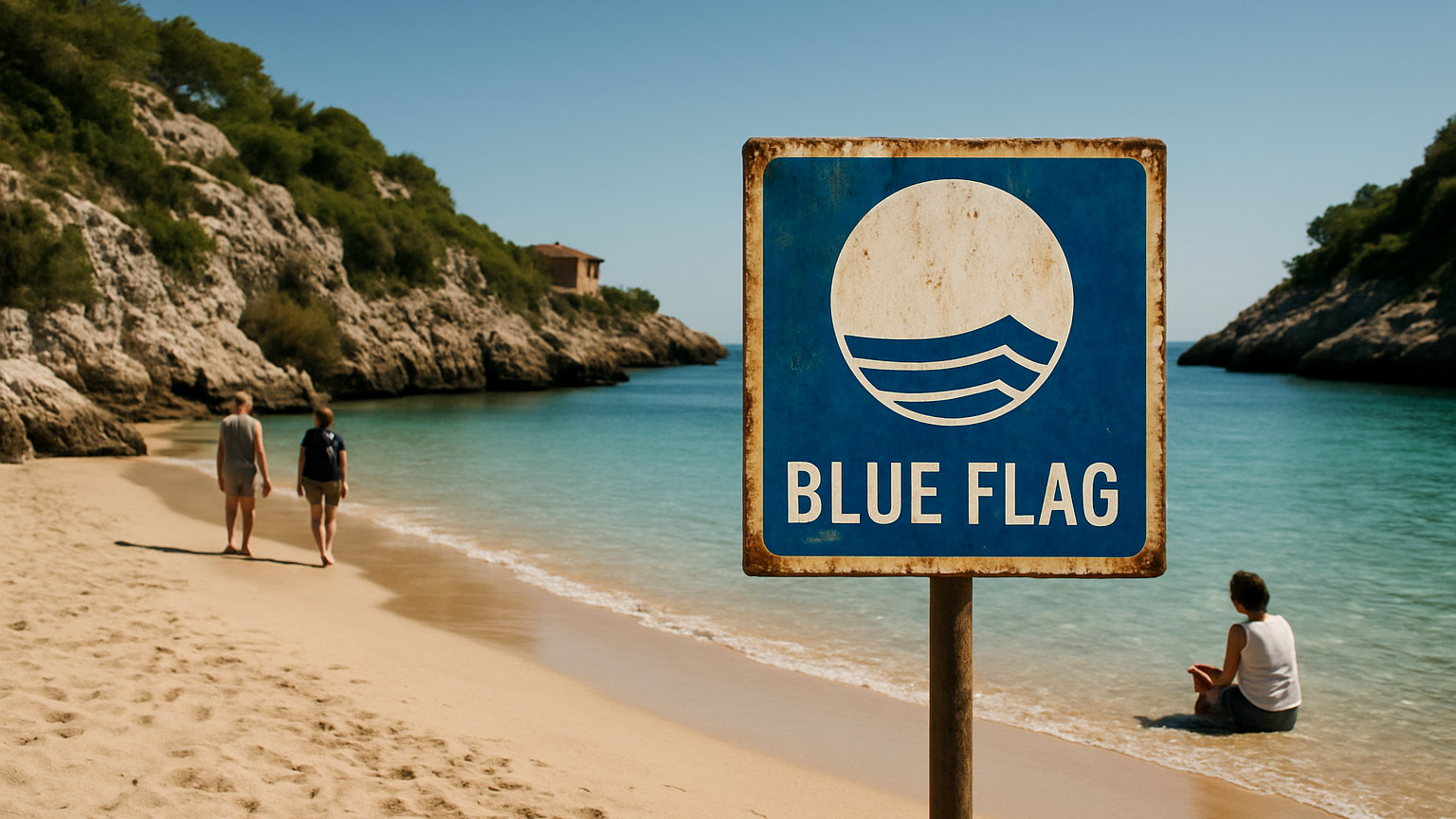
The Blue Flag is the most widely recognised beach award in Europe and one of the most widely misread. It is run by an international environmental foundation, renewed annually, and awarded against a list of criteria that is entirely public. Understanding what is on that list, and what is not, makes it a genuinely useful signal rather than a vague badge of quality.
What does it certify?
Four groups of criteria. Bathing water quality, tested repeatedly through the season against strict bacterial limits. Environmental management, including waste, recycling and protection of any sensitive habitat. Safety provision, meaning lifeguards or rescue equipment, first aid and public access. And environmental education, which requires information boards and activities.
What does it not tell you?
Almost everything people actually want to know. It says nothing about whether the beach is sand or pebble, whether the water is shallow or drops away, whether there is shade, how crowded it gets, whether it is scenic, or whether the sea is warm. A Blue Flag beach can be a concrete platform beside a busy road, and a spectacular empty cove can have no flag because nobody applied.
Why do some good beaches have no flag?
Because it is an application rather than an inspection regime. A municipality must apply, meet the facility requirements and pay a fee. Remote beaches with no road access, no lifeguard and no toilets cannot qualify however clean and beautiful they are, which excludes a large proportion of the best beaches in Greece, Sardinia and Croatia.
Which countries have the most?
Spain has led the European count for many years, followed by Greece, Turkey, Italy and Portugal. That partly reflects genuine water quality and partly reflects how organised and well-funded the coastal municipalities are, so the ranking is a poor guide to which country has the best beaches.
How useful is it in practice?
As a hygiene check, genuinely useful, particularly with children. It tells you the water has been tested and that there will be lifeguards, toilets and someone responsible for the beach. Use it to rule beaches out rather than to rule them in, and never use it as a substitute for looking at photographs and a satellite view.
Are there other ratings worth knowing?
The European Environment Agency publishes annual bathing water results for every designated beach in the EU, which is the underlying data and is more detailed than the flag itself. It classifies water as excellent, good, sufficient or poor, and the results are searchable by beach. For anyone concerned specifically about water quality rather than facilities, that is the better source.
Should water quality worry you?
Rarely, at Mediterranean beach resorts, where the overwhelming majority of designated waters rate excellent. The exceptions tend to be beaches near river mouths, ports or large towns, and quality can drop temporarily after heavy rain when run-off enters the sea. Avoiding swimming for a day or two after a storm is sensible anywhere.
What should you check instead?
Satellite view for sand or pebble. Recent visitor photographs for crowding and shade. The walking distance from your accommodation. And the sea temperature for that specific month. Those four tell you more about whether you will enjoy a beach than any award.
Are there equivalent awards elsewhere?
Several countries run their own alongside it. Spain awards Q for Quality flags to beaches meeting a separate service standard, and Denmark and Germany use regional schemes. Greece and Turkey both publicise their Blue Flag counts heavily in tourism marketing. None of these tells you any more about sand, shade or crowding than the Blue Flag does.
Can a beach lose its flag?
Yes, and it happens every season. Flags are awarded annually and withdrawn mid-season if water quality fails or a lifeguard is not provided, so a flag in last year guide may not be flying this year. The current list is published each summer.
Which Beach Resorts Suit Teenagers? goes into more detail on a closely related question, and the rest of our Holidays section covers the wider subject.
The short answer
A Blue Flag means clean tested water, lifeguards and facilities, and nothing about sand, shade, scenery or crowds. Treat it as a safety and hygiene check, and judge everything else yourself from photographs and a map.