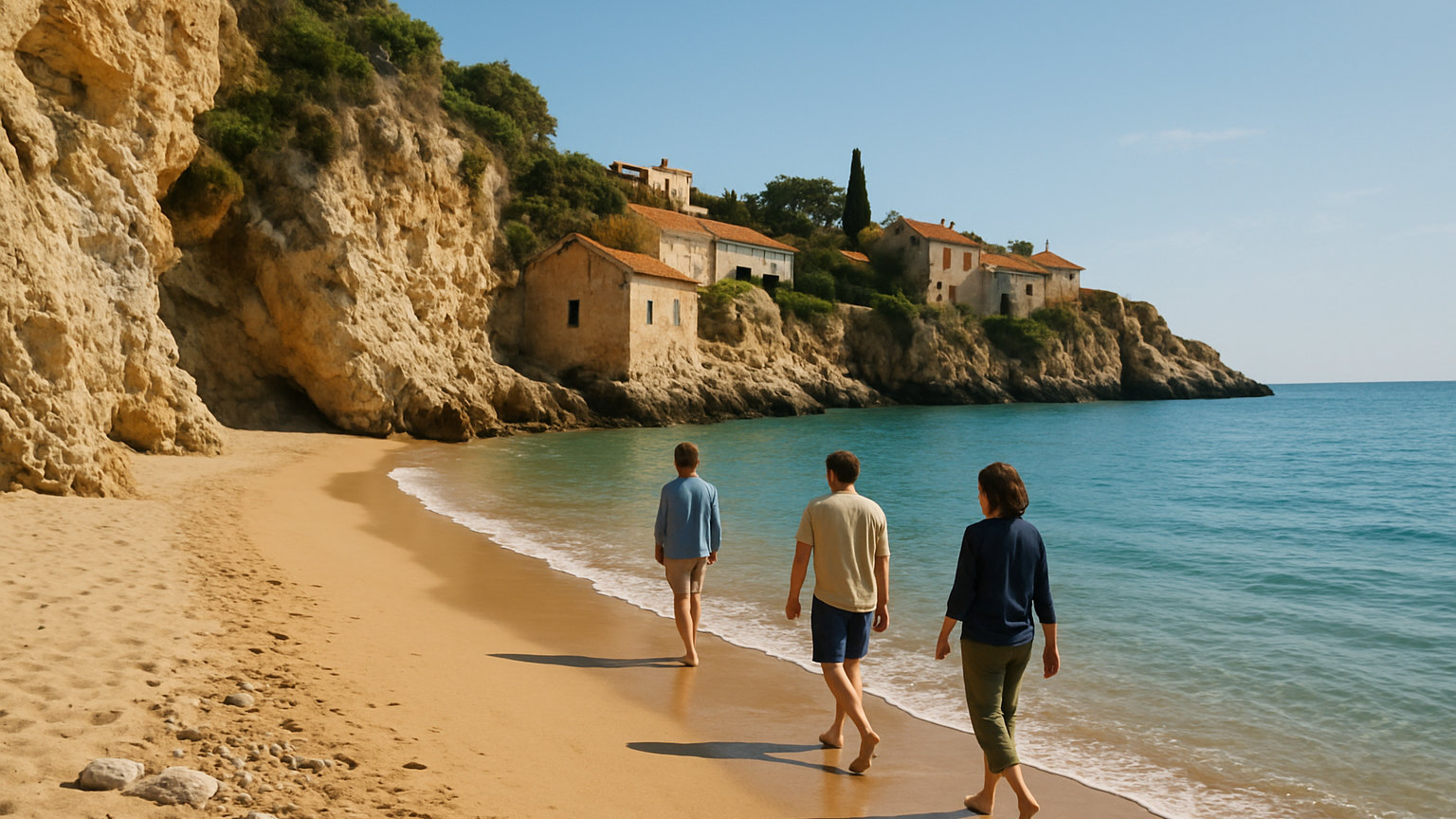
The single most useful fact about Mediterranean swimming is that the sea lags the air by around two months. It is at its coldest in February and March, well after the coldest air, and at its warmest in late August and September, well after the hottest air. That lag means the swimming season is lopsided, and the autumn half of it is better than the spring half.
What does the year look like?
April and May are cold across most of the Mediterranean, typically sixteen to nineteen degrees, and swimming is a brief dip. June climbs through the low twenties, with the eastern basin ahead of the western. July and August sit in the mid to high twenties almost everywhere. September holds the annual peak in most places, often twenty-five or twenty-six. October falls back to around twenty-three, which is still warmer than June. November drops below twenty and the season closes.
Which is warmer, June or October?
October, almost everywhere, and usually by two or three degrees. This is the fact that reshapes most people beach holiday planning once they know it. An early October week in Greece, Cyprus or southern Turkey gives warmer water, cooler air for walking, fewer people and lower prices than the same week in June.
Does the eastern Mediterranean differ from the west?
Yes, consistently. The eastern basin, meaning Cyprus, southern Turkey, the Levantine coast and the southeast Aegean, runs a degree or two warmer than the western Mediterranean at the same latitude, and warms earlier in the year. The Adriatic and the Gulf of Lion in southern France are the coldest parts of the sea, and the northern Adriatic in particular is slow to warm.
What is the longest season?
Cyprus, which is swimmable from roughly May to November, a full seven months, and is the only Mediterranean destination that reliably delivers that. Southern Turkey and Malta are close behind at about six months. Northern Spain, southern France and Croatia are closer to four.
Why does the sea lag the air?
Water has a very high heat capacity compared with air, so it takes far more energy to raise its temperature and far longer to lose it. A shallow enclosed bay responds faster than deep open water, which is why sheltered lagoons can be several degrees warmer than the sea a few hundred metres offshore.
Does wind change anything?
It changes how the water feels more than its temperature. A strong offshore wind can drive warm surface water away and pull colder water up from below, an effect noticeable in the Cyclades during the meltemi and on exposed Spanish coasts. Wind also makes twenty-three degrees feel considerably colder once you are out of the water.
How should you plan around it?
Check the sea temperature for the specific resort in the specific month rather than relying on air temperature or general impressions of the country. Two stretches of coast within an hour of each other can differ by several degrees, and the difference between a swimming holiday and a paddling one is often that small.
How reliable are the published figures?
Sea temperature data is generally accurate and comes from buoys and satellite readings, but it reports open water rather than the specific bay you will swim in. A shallow enclosed beach can run two or three degrees warmer on a still day and a degree or two colder after a windy night. Treat the published number as the floor rather than the exact reading.
Does the Black Sea follow the same pattern?
Broadly, with a shorter season. The Bulgarian and Romanian coasts warm quickly to around twenty-five degrees in August and cool fast, giving a usable window of roughly late June to mid-September. They are warmer than the northern Adriatic in high summer and colder at both ends of the season.
Which European Beach Holidays Are Cheapest? goes into more detail on a closely related question, and the rest of our Holidays section covers the wider subject.
The short answer
The Mediterranean is comfortably swimmable from late June to late October, peaking in September. October beats June almost everywhere. Cyprus has the longest season and the northern Adriatic the shortest, and a sheltered bay always beats open water early in the year.