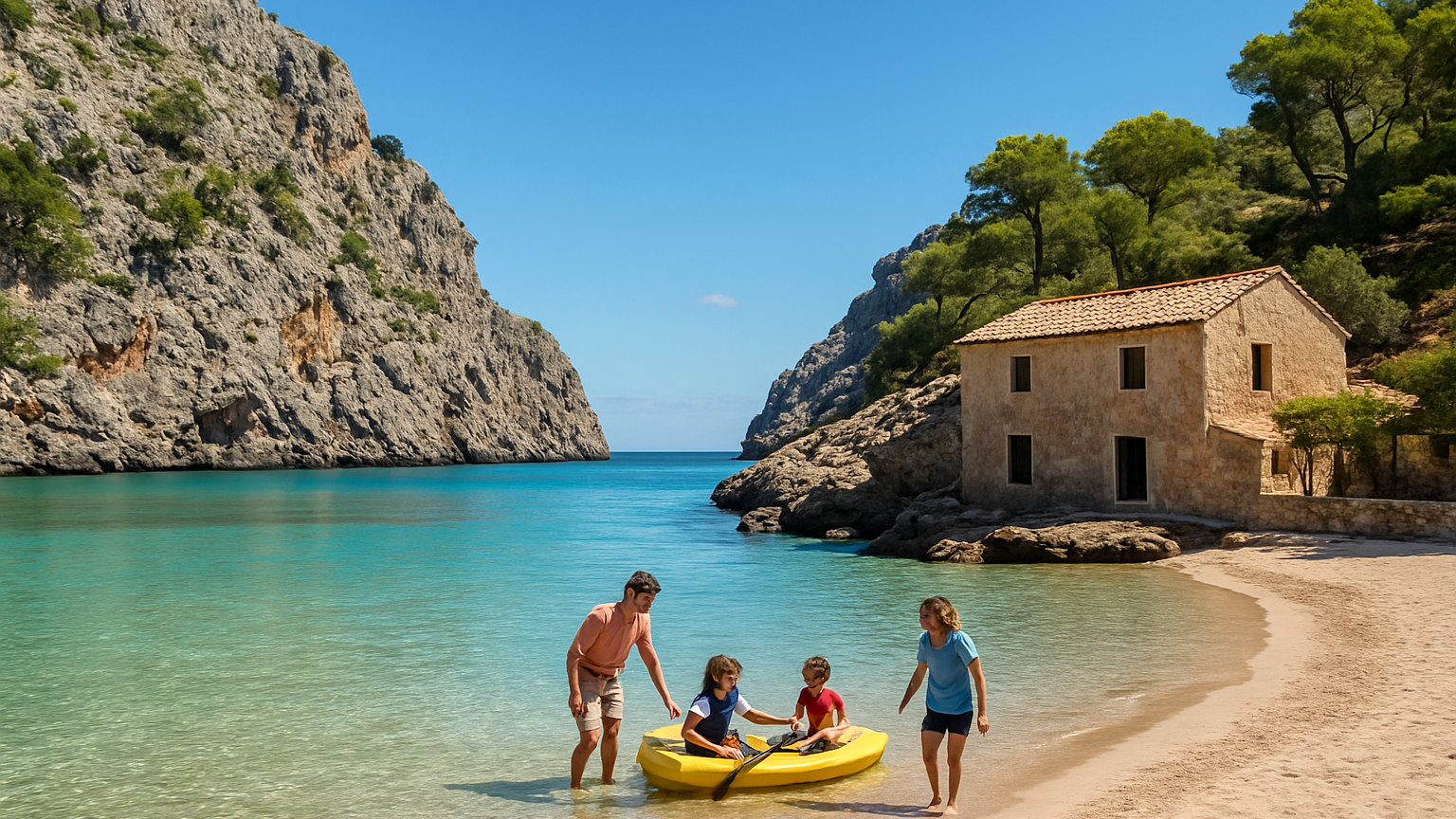
The features that make a beach work with children are specific and checkable, and they exclude most of the dramatic ones. Shallow calm water, shade, a short carry from the car and somewhere to buy a drink account for almost the whole of it.
What matters most?
A gradual shelving entry into calm shallow water, which lets children stand and play rather than swim. Steep-entry beaches where the depth changes within a few metres are unsuitable regardless of how attractive they are.
Which coasts do this best?
The Balearics, with sheltered calas and shallow bays. The southern Algarve, protected from Atlantic swell. Crete south and east coasts. The Turkish coast. The Adriatic side of Italy, which is shallow for a long way out and warms quickly.
Why does shade matter so much?
Because children burn faster and tire sooner, and a beach with no shade limits a family to a couple of hours. Pine-backed beaches, which are common in Italy, Croatia, Greece and Turkey, are consistently the easiest with young children.
What facilities are needed?
Toilets, fresh water for rinsing and somewhere to buy food, in that order. A beach with none of these is manageable for a morning and difficult for a day. Blue Flag beaches reliably have all three, which is their main value to families.
What about the walk?
Decisive. Carrying a child, a bag, shade and equipment down four hundred steps is the difference between a good day and an ordeal. Beaches with parking within a few minutes are worth choosing over better beaches further away.
Which should you avoid?
Atlantic surf beaches with rip currents, any beach flying a red flag, steep-entry pebble beaches and anywhere unpatrolled if the children are young. The Portuguese and French Atlantic coasts are beautiful and demand strong swimming.
What about supervision?
Continuous and by a named adult, which sounds obvious and is the thing that fails in groups. Agreeing explicitly who is watching, rather than assuming another adult is, is the single most effective precaution on any beach or pool.
Armbands and inflatables are toys rather than safety devices, and inflatables in particular drift offshore quickly in an offshore wind.
What should you take?
More shade than you think, a rash vest, which is better than repeated sun cream, swim shoes for pebble or rocky shores, and considerably more water than expected. A pop-up tent gives shade and somewhere for a nap.
What time should you go?
Early morning and late afternoon, which is what local families do everywhere in southern Europe. The middle of the day is the hottest, busiest and most difficult, and avoiding it entirely makes a beach holiday considerably easier.
What about the sea state?
Worth checking daily rather than assuming, since the same bay can be flat one morning and choppy the next depending on the wind. Local families move beaches according to the wind direction, and asking at the hotel which beach is sheltered today is a normal question.
Are there beaches with shallow water a long way out?
The Italian Adriatic and parts of the Baltic, where you can walk a considerable distance and stay waist deep. For toddlers this is ideal, and it also means the water warms quickly and is often several degrees above the open sea.
What about lake beaches?
Frequently better with small children than the coast. No waves, no currents, no salt and usually a grassy area with a lido, which the Italian, Austrian and Slovenian lakes all provide.
Which countries are easiest?
Spain, Italy, Portugal and Greece, all of which welcome children everywhere and where beach infrastructure assumes families. Facilities, shade and food are all straightforward, and nobody minds a noisy toddler on a beach or in a restaurant.
See also Where Are Europe Most Dramatic Beaches?, which covers a related part of the same decision, and our other Inspiration guides.
The short answer
Look for shallow calm water, natural shade, short parking and toilets, which the Balearic calas, the southern Algarve and the Italian Adriatic all provide. Avoid Atlantic surf beaches and steep entries, name an adult to supervise, and go before ten or after four.