
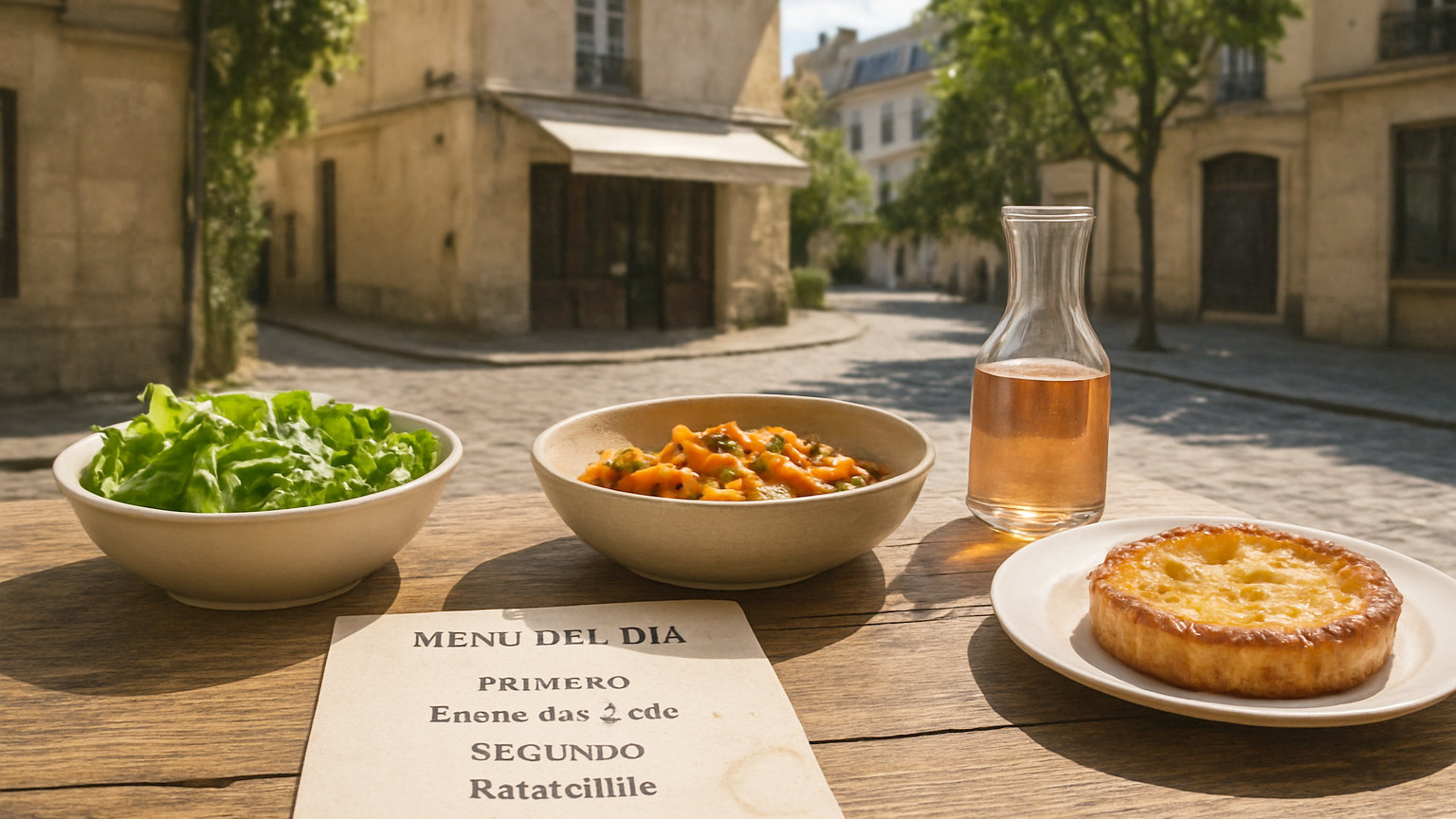
Across France, Spain, Italy and Portugal there is a weekday lunch offer aimed at people working nearby: several courses at a fixed low price, cooked by the same kitchen that charges several times as much in the evening. It is the best value in European eating and many visitors never encounter it.
What is it in Spain?
The menu del dia, a legally established weekday lunch of a starter, a main, bread, a drink and usually dessert or coffee, at a fixed price. It is served roughly from one to four and is available in ordinary restaurants everywhere.
And in France?
The formule or menu du jour, usually two or three courses at lunch on weekdays, frequently chalked on a board. French restaurants that are expensive in the evening are frequently very reasonable at lunch, including starred ones.
What about Italy?
The pranzo di lavoro or menu fisso, less universal than in Spain and common in working districts and near markets. Many Italian restaurants also do a lunch offer without advertising it, which is worth asking about.
And Portugal?
The prato do dia, a dish of the day at lunch, frequently with soup and a drink included. Portuguese lunch portions are substantial and the prices among the lowest in western Europe.
Why is it so much cheaper?
Because it is aimed at regular weekday custom rather than occasional diners. The kitchen cooks a limited number of dishes in quantity, the margin is thin and the volume is reliable. It is a different business from the evening service.
Is the food as good?
Frequently, and it is usually simpler. The set lunch is the everyday cooking of the region rather than the restaurant showcase, which for most visitors is the more interesting of the two.
When is it available?
Weekdays almost everywhere, and rarely at weekends or on holidays, which is when restaurants make their money from leisure diners. This is the main limitation and it is worth planning around.
How do you find it?
A board outside or a separate card on the table, frequently only in the local language. Asking whether there is a menu del dia, a formule or a prato do dia is usually enough, and places that have one will say so.
Does it work at good restaurants?
Particularly well. A serious restaurant in Paris, Lyon or San Sebastian at lunch can be a fraction of its evening price, which is how most people experience the upper end of European eating affordably.
What is the catch?
Limited choice, usually two or three options per course, and no substitutions. Given the price that is entirely reasonable, and anyone with dietary requirements should check what is available rather than assuming flexibility.
Is there an evening equivalent?
Less common and worth looking for. Some restaurants run an early evening set menu before the main service, and tasting menus at the upper end are frequently better value than ordering the same dishes separately. Neither matches the weekday lunch for value.
What about drinks?
Usually included in Spain and Portugal, where wine, beer or water comes with the menu del dia at no extra charge. In France a drink is sometimes included in the formule and often not. This is part of why the Iberian version is the best value in Europe.
Where is it most common?
Working districts, near markets, offices and industrial areas rather than in the centre. A restaurant on a residential street full of people in work clothes at half past one is serving exactly this, and it is frequently the best meal of the trip.
Which European Countries Are Best for Vegetarians? answers a related question in more depth, and there is more of the same across our Inspiration guides.
The short answer
The menu del dia in Spain, the formule in France, the pranzo di lavoro in Italy and the prato do dia in Portugal are weekday fixed-price lunches at a fraction of evening prices. Ask for it by name, expect limited choice, and use it to eat at restaurants you could not otherwise afford.


