San Marino claims to be the oldest surviving republic in the world and occupies a limestone ridge rising abruptly from the plain near Rimini. The historic centre sits on top, it is compact and steep, and a day covers it comfortably.
What are the three towers?
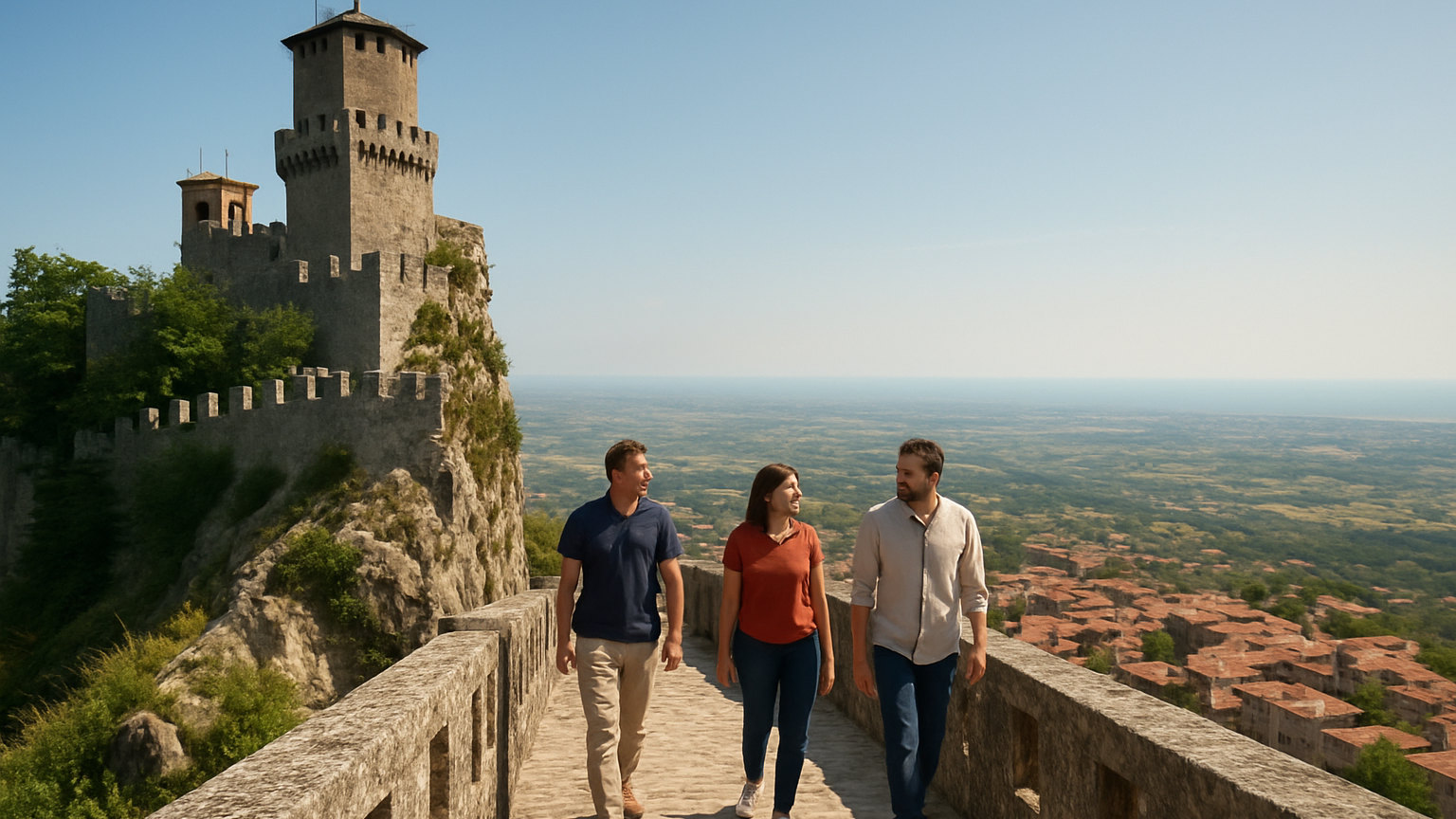
Guaita, Cesta and Montale, strung along the crest of Monte Titano and the symbol of the republic. The first two can be entered on a combined ticket and the third is exterior only. The walk between them along the ridge is the best thing in the country.
What are the views like?
Exceptional, and the reason to go. On a clear day the Adriatic coast, the Rimini beaches and the Apennines are all visible from the walls, several hundred metres below.
What else is in the centre?
The Palazzo Pubblico with a changing of the guard in summer. The Basilica del Santo. Several small museums of variable quality. A great many shops selling duty-free goods, weapons and souvenirs, which dominate the main streets.
How do you get there?
By bus from Rimini, around forty-five minutes and inexpensive, which is how most visitors arrive. There is no airport and no railway. By car, park below and take the cable car or the lifts up.
Is the cable car worth it?
Yes. It runs from Borgo Maggiore to the historic centre in a couple of minutes and saves a substantial climb, with a good view on the way up.
Can you get a passport stamp?
From the tourist office for a small fee, as a souvenir rather than an official entry record. There is no border control arriving from Italy.
Is the shopping worth anything?
San Marino is outside the EU customs territory, which historically made electronics, alcohol and tobacco cheaper. The savings are smaller than the marketing suggests, and UK allowances on bringing goods home should be checked before buying.
How long do you actually need?
Four to six hours, including the towers and lunch. Staying overnight is worthwhile for one specific reason: the day-trip coaches leave in the late afternoon and the town becomes very quiet, with the evening light on the walls.
When should you go?
Spring and autumn. Summer brings heat, crowds from the Rimini beach resorts and full coach parties, and the ridge has little shade. Winter can be cold and misty at altitude, which sometimes removes the view entirely.
Is it suitable for everyone?
The centre is steep, cobbled and involves many steps, with the tower paths narrow and exposed in places. Mobility access is limited by the terrain, though lifts from the car parks help considerably.
Is it worth the trip?
For the setting and the walk between the towers, yes. As a shopping destination, no. It is a half day of genuine drama surrounded by a great deal of souvenir retail.
What is the history?
San Marino traces its foundation to the fourth century and has maintained independence through the unification of Italy and both world wars, which is the basis of its claim to be the oldest surviving republic. The historic centre and Monte Titano are a world heritage site.
What currency is used?
The euro, by agreement, and the republic mints its own coins which are collected. Cards are widely accepted and prices are broadly Italian.
Is it busy?
Very, between about eleven and four in summer, when coaches arrive from the Adriatic resorts. The ridge and the towers absorb people better than the shopping streets, and the crowd thins considerably in the late afternoon.
Where should you eat?
Away from the main route. Restaurants on the terraces with views charge accordingly, and the food is Romagnol rather than distinctly Sammarinese.
It is worth reading alongside How Long Do You Need in Vatican City?, which takes a different angle, and the wider Inspiration guides.
The short answer
Four to six hours covers it: the cable car up, the three towers, the ridge walk and the views to the Adriatic. Come by bus from Rimini, go in spring or autumn, and stay the night if you want the town after the coaches leave.