Europe has waymarked trails, mountain huts, coastal paths and pilgrim routes on a scale no other continent matches, and much of it is accessible without equipment or experience. The range runs from a two-hour coastal path to a month on foot.
Which are the great long-distance routes?
The Camino de Santiago, with several routes across Spain and France, the best known being the Camino Frances at around eight hundred kilometres. The Tour du Mont Blanc, a circuit of roughly eleven days. The GR20 in Corsica, which is genuinely hard.
The Alta Via routes in the Dolomites and the Portuguese Rota Vicentina are both excellent and less demanding.
What about coastal paths?
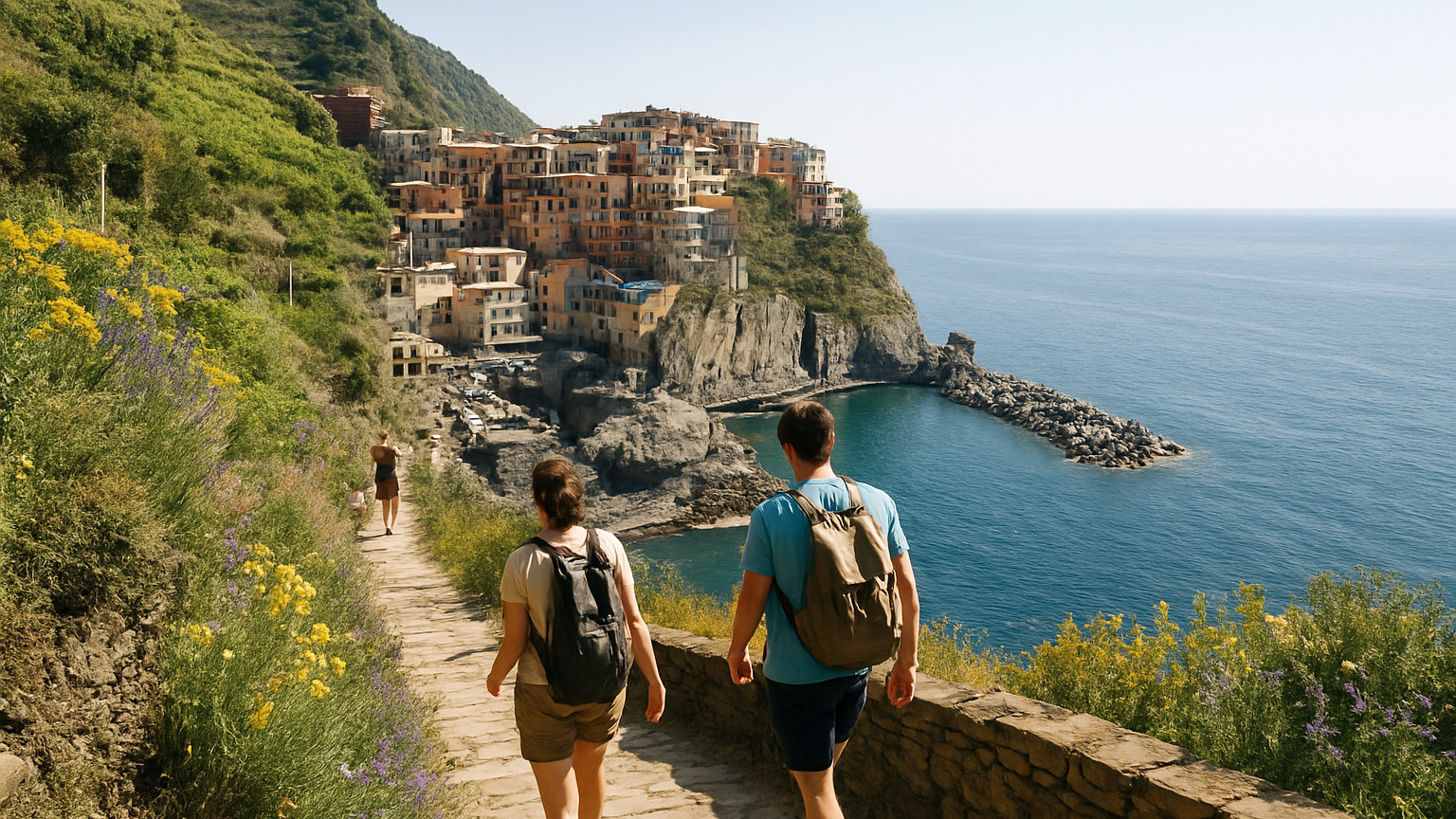
The Cinque Terre paths in Italy, the Amalfi Path of the Gods, the Rota Vicentina in Portugal, the Cornish and Pembrokeshire coast paths, and the Zingaro reserve in Sicily. All are day walks or short multi-day routes with accommodation along them.
Which need no experience?
A great many. Alpine valley walks reached by cable car, Italian and Spanish village-to-village paths, canal towpaths and the shorter coastal sections are all straightforward in ordinary shoes with water and a map.
What is hut-to-hut walking?
The alpine tradition of walking between staffed mountain refuges that provide a bed and a meal, so you carry only a day pack. Austria, Switzerland, Italy and Slovenia all have extensive networks, and it is the best way to spend several days in the mountains without camping.
Huts must be booked ahead in summer and frequently take cash only.
When is the season?
Mountains from late June to late September, once the snow has cleared and while the huts are open. Mediterranean coastal and island walking is best from March to May and in October, and unpleasant in July and August heat.
What about safety?
Mountain weather changes quickly and is the main hazard. Checking the forecast, turning back when conditions deteriorate, carrying layers and water, and telling someone your route are the basics. Alpine rescue is charged, so insurance covering mountain walking matters.
How are routes marked?
Well, by international standards. Most European countries use painted waymarks on rocks and trees, with national systems such as the French GR red and white stripes and the Italian CAI numbering. A local map remains worth carrying.
What about the Camino specifically?
A distinct thing, with a network of pilgrim hostels, a credential stamped along the way and a certificate for the final hundred kilometres. It can be walked in sections over years, and the last hundred kilometres from Sarria is the busiest part.
Which are best for a day?
Samaria gorge in Crete, the Path of the Gods above Amalfi, Seceda to Ortisei in the Dolomites, the Caminito del Rey in Spain, and any stage of the Cinque Terre path.
What should you carry?
Water, more than expected, along with layers, sun protection and proper footwear. Boots with ankle support for mountains and rough ground; trainers are adequate for coastal paths and valley walks. A paper map or an offline map, since signal is unreliable.
Can you do it without planning a whole trip?
Easily. Almost every European holiday region has waymarked day walks published by the local tourist office, frequently free and graded by difficulty. Asking for the local walking map on arrival is the simplest way into it.
Which countries are easiest to walk in?
Austria, Switzerland, Italy, Slovenia and France, all with dense waymarked networks, published maps, huts and public transport reaching trailheads. Spain and Portugal have improved greatly, and eastern Europe offers excellent walking with less infrastructure.
Is there accommodation on the routes?
On the established ones, plentifully. Pilgrim hostels on the Camino, mountain huts in the Alps and small hotels along the coastal paths all cater specifically to walkers, and several companies will move your luggage between them for a modest fee.
See also What Can You Do on a Rainy Day?, which covers a related part of the same decision, and our other Inspiration guides.
The short answer
The Camino, the Tour du Mont Blanc and the Dolomite Alta Vie are the great long routes; the Rota Vicentina, the Path of the Gods and the Cinque Terre are the best coastal ones. Hut-to-hut walking needs only a day pack, and mountain season runs late June to late September.