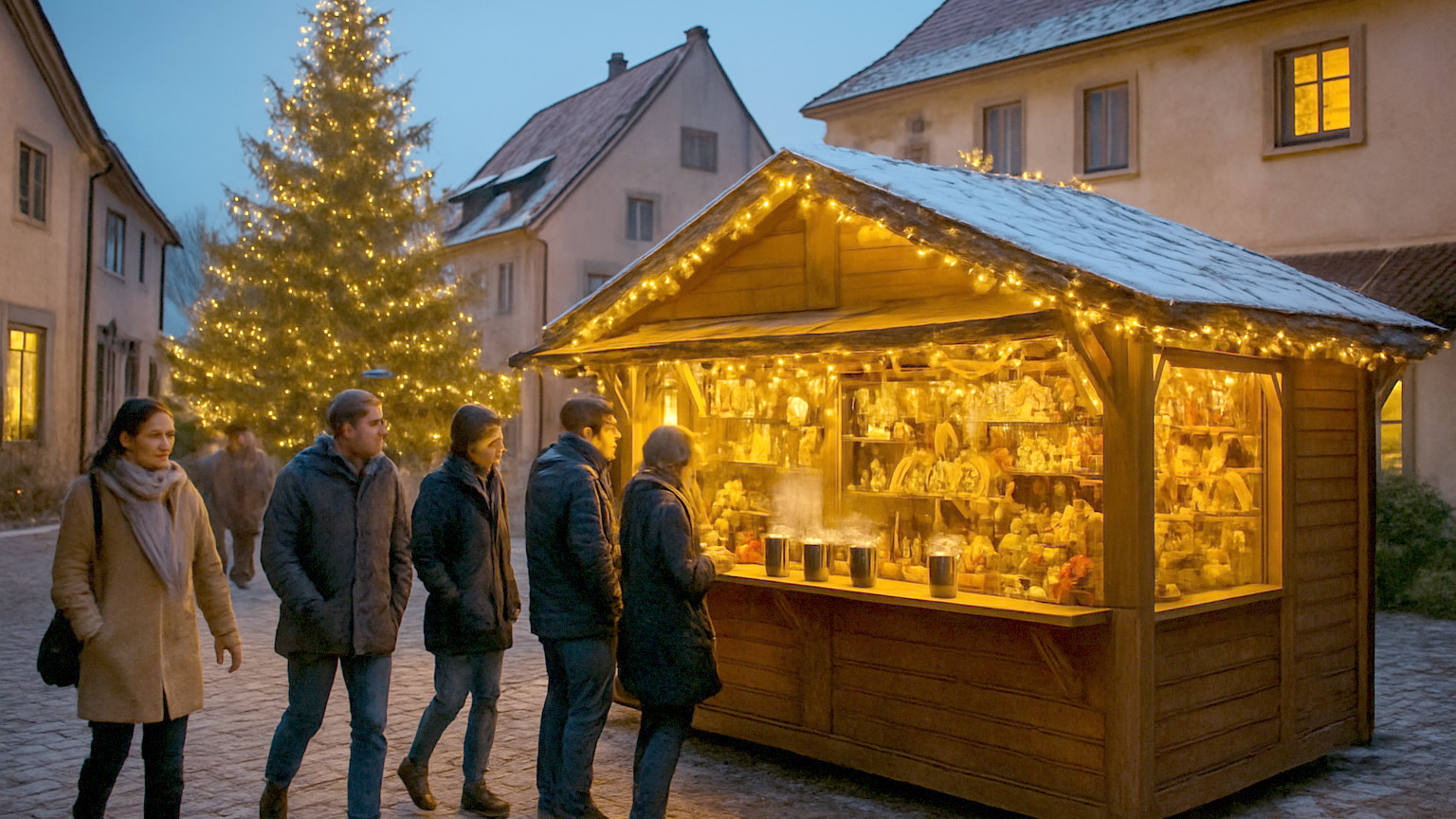
Christmas markets sell two quite different things side by side: genuine regional crafts made nearby, and mass-produced goods imported and sold at market prices because visitors are in a buying mood. Telling them apart is not difficult once you know what each region actually makes.
What is worth buying in Saxony?
Erzgebirge wooden crafts, made in the mountain villages south of Dresden for around three hundred years. Nutcrackers, smoking figures, candle arches and Christmas pyramids are all made there, and the workshops in Seiffen still produce them. Genuine pieces carry a maker mark and cost accordingly.
And in Thuringia?
Glass ornaments from Lauscha, where the tradition of blown glass Christmas baubles began in the nineteenth century. Hand-blown and hand-painted pieces are still made there and sold at markets across Germany, and they are distinguishable from machine-made versions by slight irregularities.
What about food to take home?
Nuremberg Lebkuchen and Dresden Stollen, both of which carry protected designations meaning they must be made in those cities to a defined recipe. Both travel well. Honey, spirits, spice mixes and dried fruit are widely sold and are usually local.
What is worth buying elsewhere?
In Alsace, pottery and textiles, particularly printed table linen. In Austria, wool goods and candles. In Poland, amber and hand-painted ceramics from Boleslawiec. In Czechia, glass and wooden toys. In Hungary, embroidery and paprika.
What should you avoid?
Anything generic sold at multiple markets in multiple countries: mass-produced baubles, plastic decorations, imported ornaments and novelty items. These are stocked because they sell rather than because they are local, and they cost more at a market than in a shop.
How do you spot the real thing?
The stallholder usually makes it and will tell you where. Hand-made pieces have slight variations between them. Prices reflect labour, so a genuine carved figure costs considerably more than a similar-looking imported one. Several markets, Nuremberg in particular, regulate what may be sold.
Is it expensive?
Craft items are priced for what they are and are not cheap. The same object in a shop in the same town is often similar or slightly less, since market stalls pay a premium for the pitch. You are paying partly for the occasion, which is a reasonable thing to do knowingly.
Should you haggle?
No. Prices at German, Austrian and central European markets are fixed and haggling is not part of the culture. It is likely to be received poorly rather than as a negotiation.
Do you need cash?
Frequently, particularly in Germany where many stalls remain cash only. Larger craft stalls increasingly take cards. Carry small notes, and be aware that change for large notes can be slow on a busy evening.
What about getting it home?
Glass and ceramics need packing properly, and most stalls will wrap them. Hand luggage restrictions apply to liquids including spirits and honey, so anything of that kind needs to go in a hold bag. Wooden items travel without difficulty.
What about buying online instead?
Several of the Erzgebirge and Lauscha workshops sell directly and ship, which is worth knowing if you see something and do not want to carry it. Buying at the market supports the stallholder and the shipping option removes the risk of breaking it in a suitcase.
Are there Christmas shops open year round?
Yes, and the best known is in Rothenburg ob der Tauber, which sells German Christmas decorations every day of the year and is a genuine attraction in its own right. Seiffen in Saxony has workshops and shops open outside the season too.
What makes a good gift?
Small wooden figures, glass ornaments and food, all of which travel well and are unmistakably from where you bought them.
Which Christmas Markets Suit Families? is the natural next read, alongside the wider Seasons section.
The short answer
Buy Erzgebirge wooden crafts in Saxony, Lauscha glass in Thuringia, and Nuremberg Lebkuchen or Dresden Stollen to take home. Avoid the generic imported decorations sold at every market, carry cash, and do not haggle.