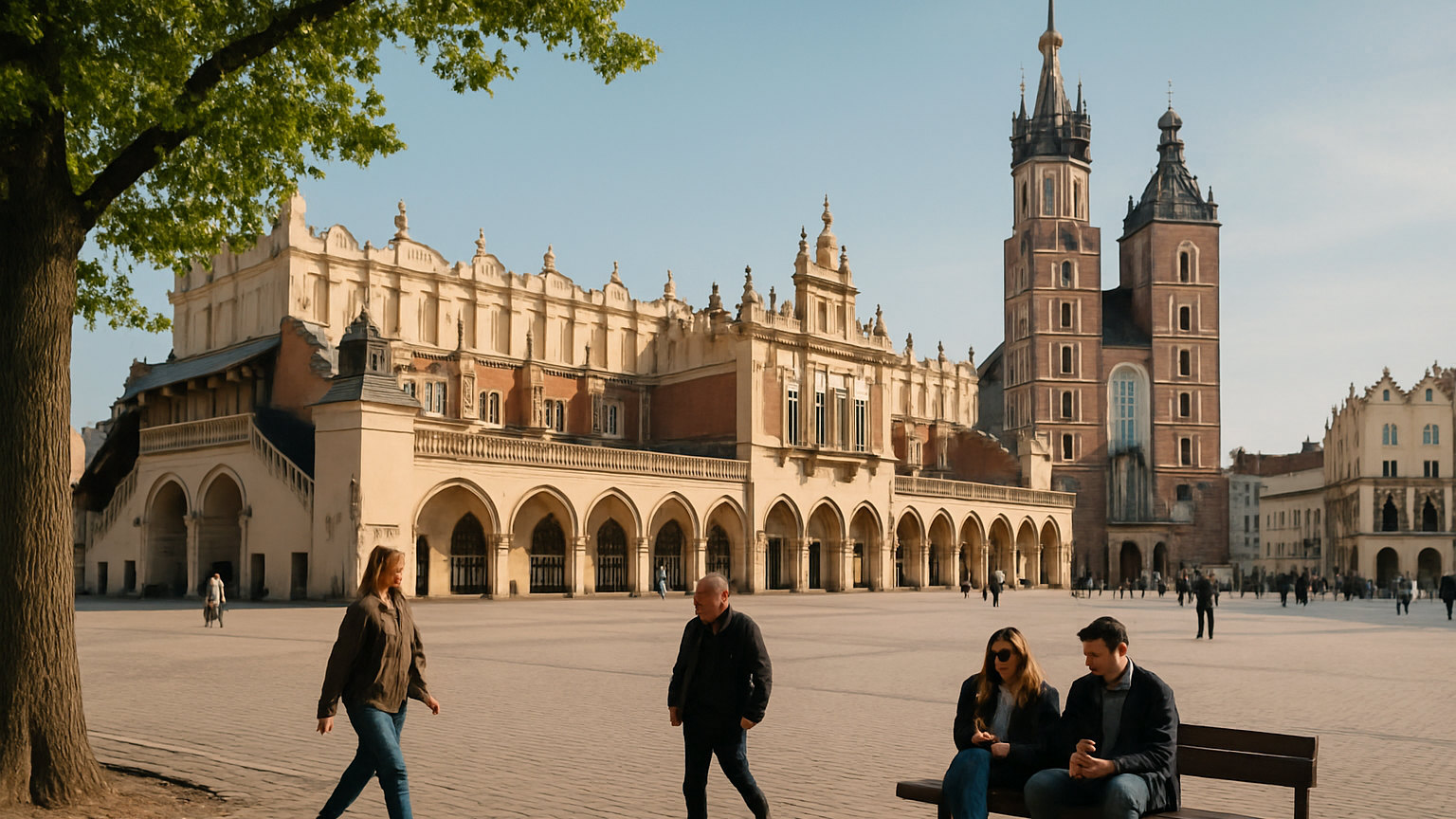
Krakow came through the war largely intact, which is why its old town is one of the most complete medieval centres in Europe and why the main square is the largest of its kind on the continent. It is also the base for two of the most significant excursions in Europe, both of which require planning well before you arrive.
How long do you need?
Four nights. Two days covers the old town, Wawel and Kazimierz. Auschwitz-Birkenau takes a full day and should not be combined with anything else. The salt mine is a half day. Three nights forces a choice between the two excursions.
What are the essential sights?
The Rynek Glowny, the main square, with the Cloth Hall in the middle and a trumpet call sounded from St Marys tower every hour that breaks off mid-phrase. Wawel Castle and cathedral on the hill above the river. St Marys Basilica for the carved wooden altarpiece. The Rynek Underground museum beneath the square, built around the excavated medieval market level.
What is Kazimierz?
The historic Jewish quarter, twenty minutes walk from the square, with seven surviving synagogues, the Galicia Jewish Museum and a street life of bars and small restaurants that has made it the most interesting district in the city. Across the river in Podgorze are the ghetto memorial and Schindlers Factory, which is a museum of the wartime occupation rather than a film location.
How do you visit Auschwitz?
Entry is free but requires a timed ticket, and the slots go months ahead in summer. Guided tours in English are the usual option and are the better experience. It is around ninety minutes from Krakow by bus or organised transport, and the visit covers both Auschwitz I and Birkenau, taking three and a half hours minimum. Plan nothing else for that day.
Is the salt mine worth it?
Wieliczka is a UNESCO site and a working mine for seven hundred years, with chapels, chandeliers and sculptures carved from rock salt hundreds of metres underground. The tourist route involves around eight hundred steps down and a lift back up. It is a half day and is genuinely impressive rather than a filler.
Where should you stay?
The old town for the location, or Kazimierz for lower prices, better restaurants and a fifteen-minute walk in. Kazimierz is the better choice for most people. Podgorze across the river is cheaper again and quieter.
How much should you budget?
Krakow remains among the best value city breaks in Europe, though old town prices have risen towards the western average. Poland uses the zloty, and declining the offer to be billed in pounds at a card terminal saves several per cent. A substantial restaurant meal with a drink still costs less than half a London equivalent.
When is the best time to visit?
May, June and September. December for the Christmas market in the main square, which is excellent and much cheaper than the German equivalents. January and February are very cold, often well below freezing, and the cheapest months by a wide margin.
What do people get wrong?
Leaving Auschwitz tickets until they arrive, which in summer means either no entry or an expensive third-party tour. The second is combining it with the salt mine on a single day, which some operators sell and which is far too much for one day both practically and emotionally.
How do you get around?
On foot for the old town and Kazimierz, which are fifteen minutes apart. Trams are cheap and frequent for anything further. The airport is connected to the main station by a direct train taking twenty minutes, and a single ticket covers the onward tram or bus into the centre.
It is worth reading alongside Porto City Guide: Port, Bridges and the Old Town, which takes a different angle, and the wider Destinations guides.
The short answer
Four nights in Kazimierz. Book Auschwitz as soon as your dates are fixed, give it a full day on its own, take the salt mine as a half day, and spend the evenings in Kazimierz rather than on the main square.