Astana is famous for being invented. Kazakhstan moved its capital here from Almaty in nineteen ninety-seven and built a new city on the steppe, commissioning international architects to produce a skyline from open grassland in under three decades.
What does that look like?
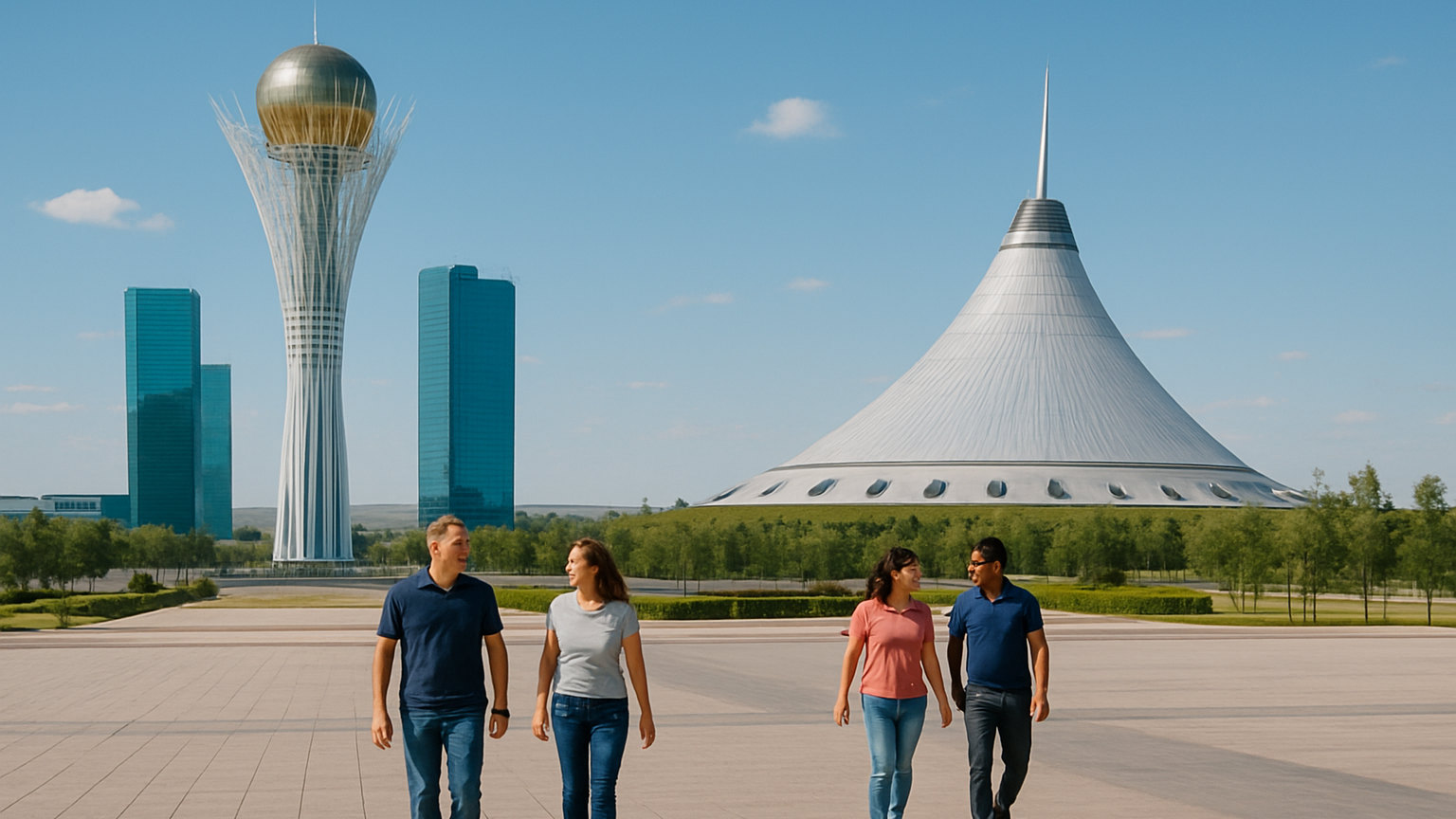
A deliberately futuristic centre of towers, domes and pyramids laid out along a ceremonial axis, alongside an older Soviet town on the other side of the river. The contrast between the two halves is the most interesting thing about the city.
What are the landmarks?
The Bayterek tower, a viewing platform on a stylised tree of life, which is the city symbol. Khan Shatyr, a tented shopping and leisure centre with a beach inside. The Palace of Peace and Reconciliation, a glass pyramid. The Hazrat Sultan mosque, among the largest in central Asia.
Is it really that cold?
Yes. Astana is one of the coldest capital cities in the world, with winter temperatures regularly below minus twenty and sometimes far lower, and strong wind across open steppe. Summers are short and hot, which is a genuinely extreme continental range.
When should you go?
May to September. Winter is an experience rather than a holiday, and several outdoor attractions are impractical for months at a time.
Is it in Europe?
Geographically Kazakhstan straddles the conventional boundary, with a western portion in Europe and the great majority in Asia. Astana sits on the Asian side. The country competes in European sporting competitions, which is why it appears on European lists.
Is it worth visiting?
As part of a wider Kazakhstan trip rather than alone. Two days covers the city comfortably, and the country offers considerably more in Almaty, the mountains and the steppe.
How expensive is it?
Moderate. Food and transport are inexpensive, and hotels in the new centre are priced for business travel and cost more than the rest of the country.
What else is there to do?
The national museum, which is substantial and covers the nomadic history well. The riverside. Burabay national park, around four hours away, with lakes and rock formations, is the usual escape from the city.
How do you get there?
Flights via Istanbul, Frankfurt or the Gulf, with some direct services from European hubs. Entry requirements for Kazakhstan should be checked before travelling, as they have changed in recent years.
How long do you need?
Two nights in the city, within a trip of a week or more taking in Almaty and the mountains.
What is the city layout?
Divided by the Ishim river. The new left bank holds the government buildings, the monuments and the towers along a planned axis; the older right bank holds the Soviet-era town, the markets and most of the ordinary life of the city.
Is English spoken?
Less than in western Europe. Kazakh and Russian dominate, with English common in hotels and among younger people in the new centre. Signage is frequently trilingual and a translation app is worth having.
What should you wear?
In winter, considerably more than you think. Temperatures well below minus twenty with open steppe wind require proper insulated clothing rather than a city coat, and locals dress accordingly. In summer the opposite applies, with real heat and little shade.
Is it walkable?
The ceremonial axis is long and the distances are greater than they look. Taxis and ride-hailing are cheap and are the practical way to move between the landmarks.
Has the city changed name?
Twice recently. It was renamed Nur-Sultan in twenty nineteen and reverted to Astana in twenty twenty-two, so older guidebooks, maps and airline systems may use either. Both refer to the same city, which is worth knowing when booking.
It is worth reading alongside Is Baku in Europe or Asia?, which takes a different angle, and the wider Destinations guides.
The short answer
Famous for being built from nothing since nineteen ninety-seven and for being among the coldest capitals on earth. See Bayterek, Khan Shatyr and the Hazrat Sultan mosque over two days, go between May and September, and combine it with Almaty.