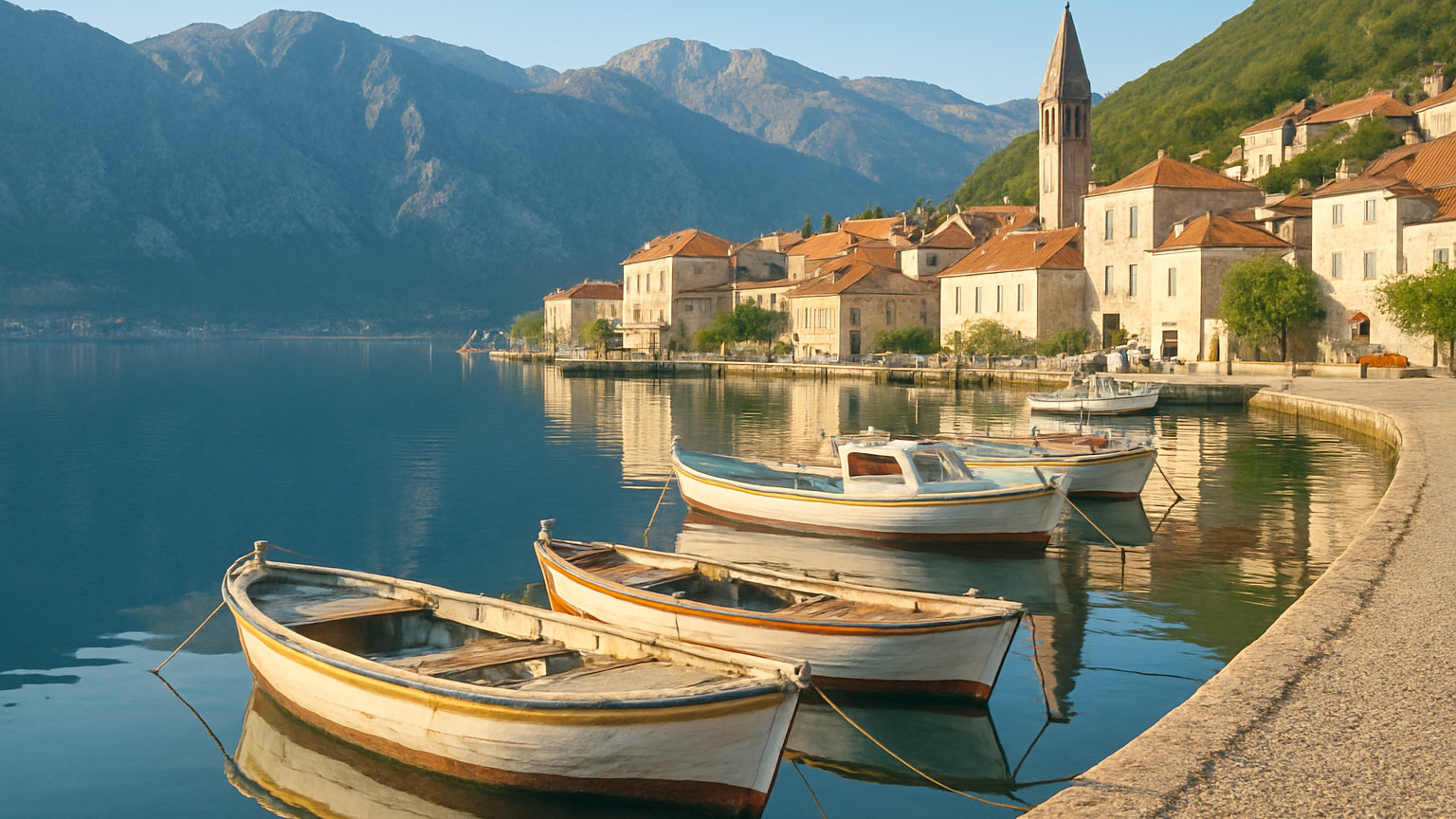
Kotor sits at the head of a deep winding inlet on the Montenegrin coast, ringed by mountains that drop straight into the water. The town is a small walled medieval settlement with Venetian squares, and behind it a fortification wall climbs the cliff face to a fortress four hundred metres above. It is among the most dramatic settings in Europe.
How long do you need?
Two or three nights. The old town is small and takes a morning. The fortress climb is a half day and the bay itself, with Perast and the island churches, fills another. Longer stays use Kotor as a base for the coast and the mountains.
Is the fortress climb worth it?
It is the best thing in Montenegro. Around thirteen hundred and fifty steps zigzag up the cliff to the fortress of San Giovanni, with the bay opening up beneath you the whole way. It takes an hour up at a steady pace. Start at first light: the steps are fully exposed, the summer heat is punishing by nine, and the early crowd is almost nobody.
What is there in the old town?
A compact grid of squares, churches and shuttered stone houses, with the cathedral of St Tryphon as the main building and a famously large population of cats. It is enclosed, walkable in fifteen minutes and best experienced in the evening after the cruise passengers leave. Kotor receives large ship arrivals in summer for a town of this size.
What is Perast?
A small baroque town across the bay, half an hour away, with no real beach, a waterfront of Venetian palaces and two islands offshore. Our Lady of the Rocks is an artificial island built by sailors dropping stones over centuries, with a church and a small museum, reached by a five-minute boat. Perast is quieter and prettier than Kotor and makes a good alternative base.
Where can you swim?
Not really in Kotor itself, where the water in the inner bay is calm and not especially appealing. The swimming is further out towards Herceg Novi, or over the mountain at Budva and the beaches south of it. This is a scenery destination rather than a beach one.
Where should you stay?
Inside the old town for atmosphere and noise, since the bars run late in a small stone space. Dobrota, just north along the bay, for quiet, waterfront apartments and a fifteen-minute walk in. Perast for the prettiest option. Budva over the hill if beaches matter more than the setting.
What else is worth a day?
The Lovcen national park above the town, reached by a road of twenty-five hairpin bends with an extraordinary view back down over the bay. Cetinje, the old royal capital, beyond it. The Ladder of Kotor, an old mule track that climbs above the fortress and is a serious half-day walk.
When is the best time to visit?
May, June and September. July and August bring heat, cruise arrivals and a coastal road that becomes very slow. Winter is quiet and often wet, since the bay is one of the wetter parts of the Mediterranean.
What do people get wrong?
Climbing the fortress at midday. The second is treating Kotor as a beach base, when the swimming is elsewhere. The third is driving the coastal road in August without allowing for the ferry shortcut across the narrows, which saves a long loop.
How do you get there?
Tivat airport is fifteen minutes away and Podgorica around ninety, both with limited schedules. Dubrovnik airport is around two hours including a border crossing that can be slow in summer, and it has far more flights, which is why many visitors arrive that way. Buses along the coast are frequent and cheap.
How much should you budget?
Cheaper than Croatia and no longer especially cheap in the old town during August. Montenegro uses the euro. Prices in Dobrota or inland are a fraction of those on the Kotor waterfront.
San Sebastian: Beaches, Pintxos and the Old Town is the natural next read, alongside the wider Destinations section.
The short answer
Three nights in Dobrota or Perast rather than inside the walls. Climb the fortress at dawn, take the boat to Our Lady of the Rocks, drive up to Lovcen for the view, and swim somewhere else.