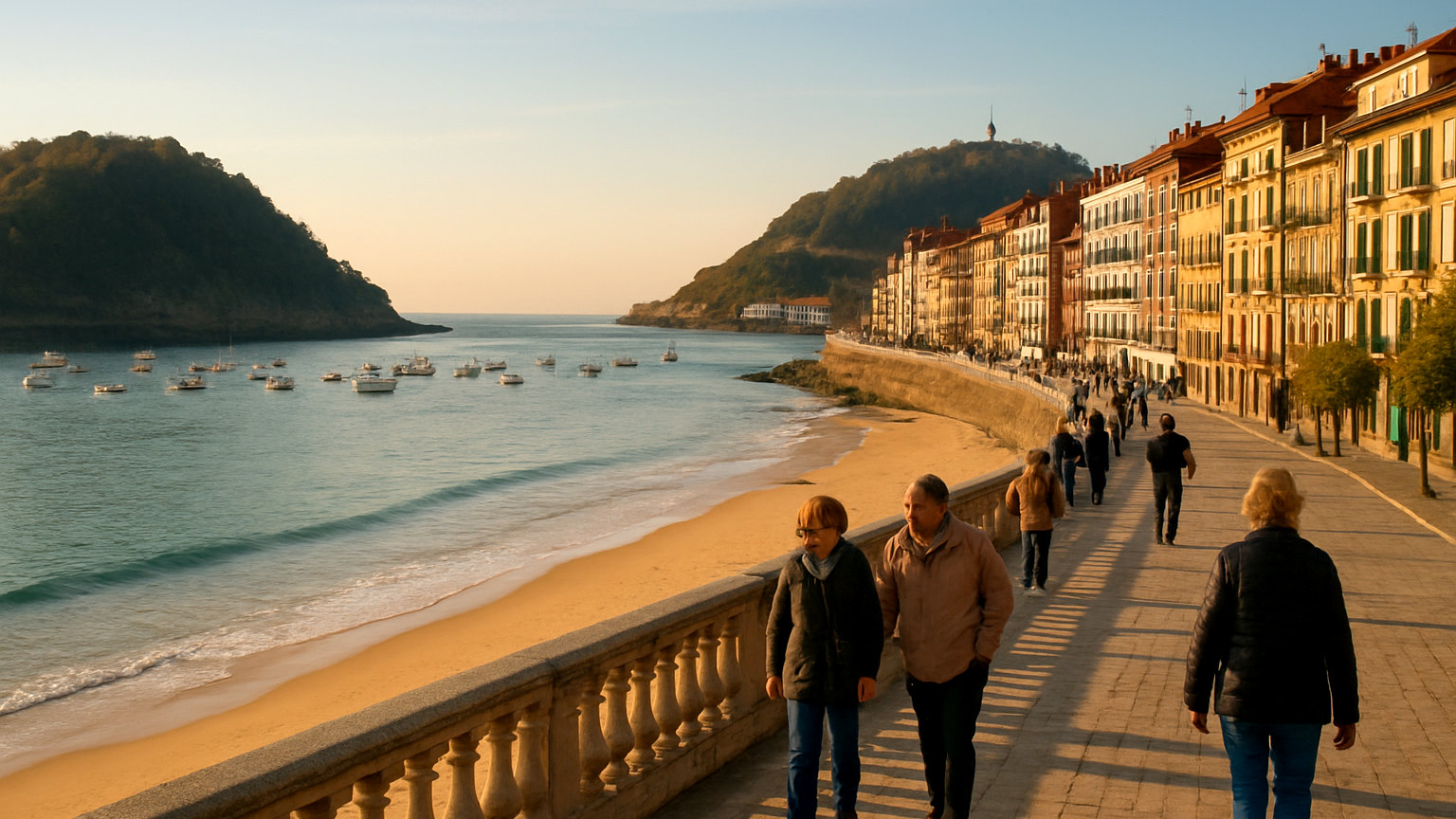
San Sebastian sits on a shell-shaped bay in the Spanish Basque Country, forty minutes from the French border. It has what is widely considered the finest city beach in Europe and a concentration of serious restaurants that is extraordinary for a town of fewer than two hundred thousand people.
How long do you need?
Three nights. The town is compact and two days covers the beaches, the old town and the viewpoints. A third allows Bilbao, the Basque coast or a trip across the border to Biarritz.
What are the beaches like?
La Concha is a perfect curve of pale sand enclosed by headlands with an island in the middle of the bay, which shelters it and makes the water unusually calm for the Atlantic. Ondarreta continues it at the western end and is quieter. Zurriola on the other side of the river is the surf beach, more exposed and younger in feel. The water is cold, rarely rising far above twenty degrees even in August.
How do pintxos work?
Pintxos are the Basque version of tapas, laid out along the bar on slices of bread or served hot from a short menu on the wall. The convention is to have one or two and a small glass of wine or cider at each bar and then move on, rather than settling in. Ask for the hot ones from the kitchen, which are usually better than the display. The old town has around a hundred bars within a few streets.
Which bars should you go to?
The Parte Vieja, the old town, is the main area, with Gros across the river quieter and increasingly good. Each bar tends to have one speciality it is known for, so ordering that rather than a selection is the local approach. Txakoli, the slightly sparkling local white, is poured from a height and is the standard accompaniment.
What are the viewpoints?
Monte Igueldo at the western end of the bay, reached by a funicular from 1912, which gives the classic view along La Concha. Monte Urgull above the old town, a free walk up to a fortress and a large statue of Christ. Both are worth doing and Igueldo is better at sunset.
Where should you stay?
The Parte Vieja for the pintxos and the noise. Centro, the grid between the old town and the river, for the best balance. Gros for lower prices, the surf beach and a more local feel. Ondarreta for quiet at the far end of the bay.
When is the best time to visit?
June and September are the best months. This is the wet, green side of Spain, and rain is possible in any month, which is what keeps the countryside so lush. July and August are busy and the Atlantic is at its warmest. The film festival in September and the Semana Grande in August both fill the town.
What is worth a day trip?
Bilbao, an hour away, for the Guggenheim. Getaria and Zarautz along the coast for beaches and grilled fish. Biarritz and Saint-Jean-de-Luz across the French border. Hondarribia, a walled town on the estuary facing France.
What do people get wrong?
Expecting Mediterranean weather and water, when this is the Atlantic and the climate is closer to Cornwall than to Alicante. The second is sitting down in one pintxos bar for the evening, which misses the entire point of the format.
How much should you budget?
San Sebastian is among the more expensive Spanish cities for accommodation, particularly in August and during the film festival. Eating, by contrast, is better value than the reputation suggests: pintxos are individually cheap and a full evening moving between bars often costs less than a sit-down dinner in Barcelona. The famous tasting menus are a separate budget entirely.
Cadiz: Beaches, Old Town and Andalusian Carnival goes into more detail on a closely related question, and the rest of our Destinations section covers the wider subject.
The short answer
Three nights in Centro or Gros. Swim at La Concha, walk up Monte Urgull, take the funicular up Igueldo at sunset, and spend both evenings moving between pintxos bars in the old town rather than settling in one.