
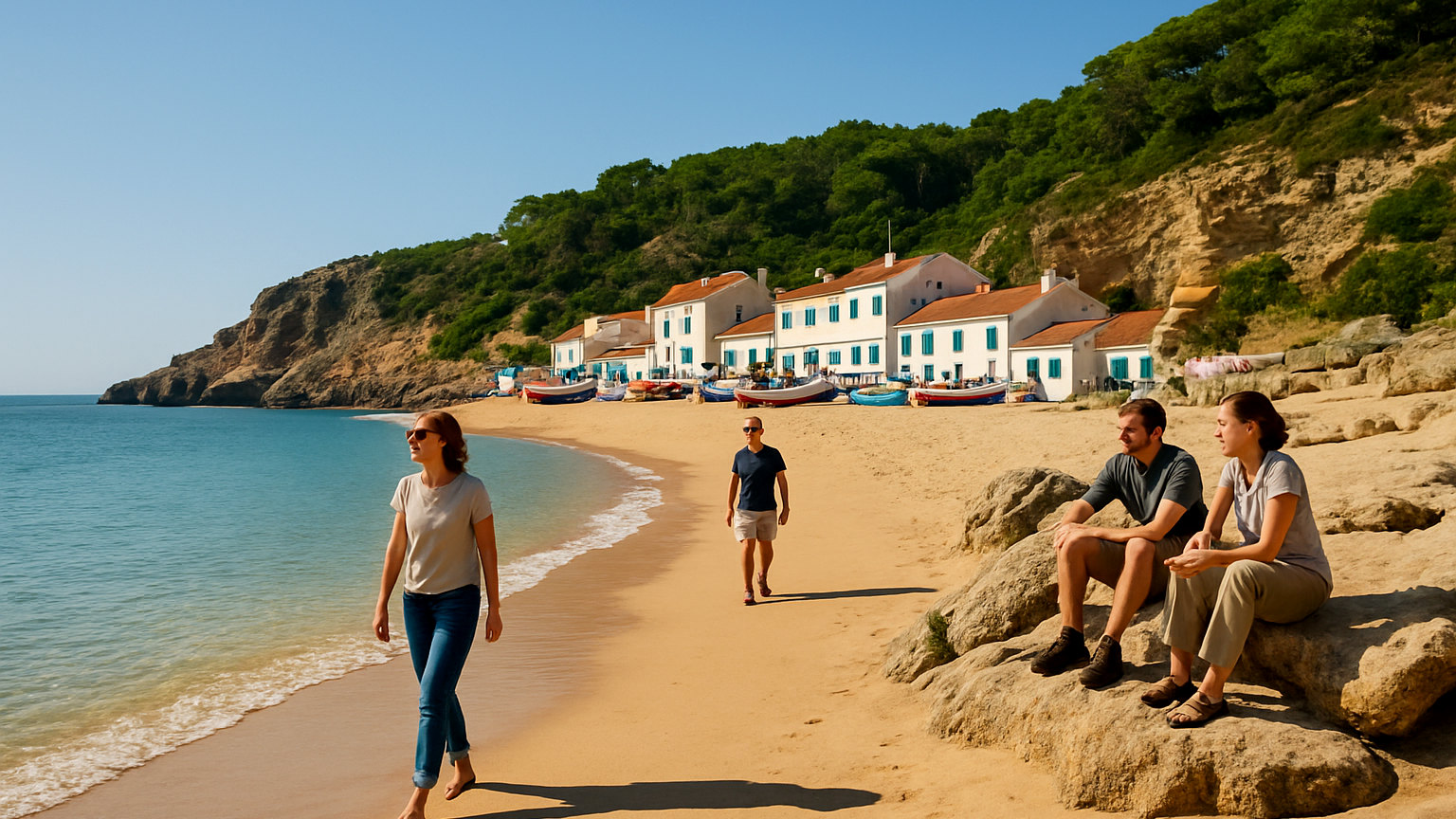
Nazare is a fishing town on the Portuguese Atlantic coast that has become famous for one reason: an underwater canyon running almost to the shore focuses swell into the largest waves ever surfed, with records set here above twenty metres. In summer it is something else entirely, a wide family beach town with a long stretch of sand.
When can you see the giant waves?
Between roughly October and March, and only when a large Atlantic swell coincides with the right wind. The biggest days are unpredictable and are usually forecast a few days ahead by the surf community, so this is not something you can book in advance with certainty. Even on ordinary winter days the sea here is dramatic.
Where do you watch from?
The Forte de Sao Miguel Arcanjo, the lighthouse fort on the headland at Sitio, which overlooks Praia do Norte where the big waves break. There is a small surfing museum inside. On big days the clifftop is crowded and the spray reaches the top, so waterproofs are sensible.
What is Sitio?
The old upper town on the cliff, reached by a funicular that has run since 1889 or by a steep road. It has a sanctuary church, a viewpoint directly over the main beach, and a more traditional feel than the seafront below. The funicular ride takes a few minutes and is the main link between the two halves of the town.
What is the summer beach like?
Praia da Nazare is a broad crescent of sand below the cliff, sheltered enough for ordinary swimming and busy with Portuguese families in July and August. It is a genuine beach holiday town in season, quite unrelated to the winter big-wave version, and the two crowds barely overlap.
What else is worth seeing?
The fish drying racks on the sand, which are still used. The women in traditional layered skirts, which is a living custom here rather than a display. The nearby monasteries at Alcobaca and Batalha, both UNESCO listed and both among the finest Gothic buildings in Portugal, within half an hour. Obidos, a walled town, is also close.
Where should you stay?
The seafront for the beach and the restaurants. Sitio on the cliff for the views and the quiet, accepting the funicular or the climb. The town is small and both are within fifteen minutes of each other.
Where should you eat?
Seafood, obviously, and this is a working fishing port so the quality is high and the prices are low by western European standards. Caldeirada, the fish stew, is the local dish. The restaurants one street back from the promenade are better value than those facing it.
How do you get there?
Around ninety minutes north of Lisbon by road, with regular express coaches from Lisbon Sete Rios. There is no useful railway station. A car makes the monasteries and Obidos easy and is not needed for the town itself.
When should you go?
October to March for the waves and the drama, July and August for the beach, and May, June or September if you want mild weather and a quiet town without either extreme. Winter accommodation is cheap except on the big swell weekends.
How much should you budget?
Nazare is among the cheapest coastal towns in Portugal outside the summer peak, and considerably below the Algarve. Seafood is inexpensive because this is a working port rather than a resort. Prices rise in July and August and on the big-swell weekends in winter, when the surf crowd arrives.
What do people get wrong?
Travelling in winter expecting to see record waves on any given day. The conditions that produce them occur a handful of times each season, and an ordinary winter visit gives you a rough sea and an empty town, which is pleasant but not the spectacle in the videos.
Anyone weighing this up will also want Saint-Malo: Walls, Tides and Brittany Beaches, along with the rest of the Destinations section.
The short answer
Two nights, timed deliberately. Winter for the waves, watched from the lighthouse fort at Sitio, with the swell forecast checked a few days out. Summer for a straightforward Portuguese beach town at a fraction of Algarve prices.


