
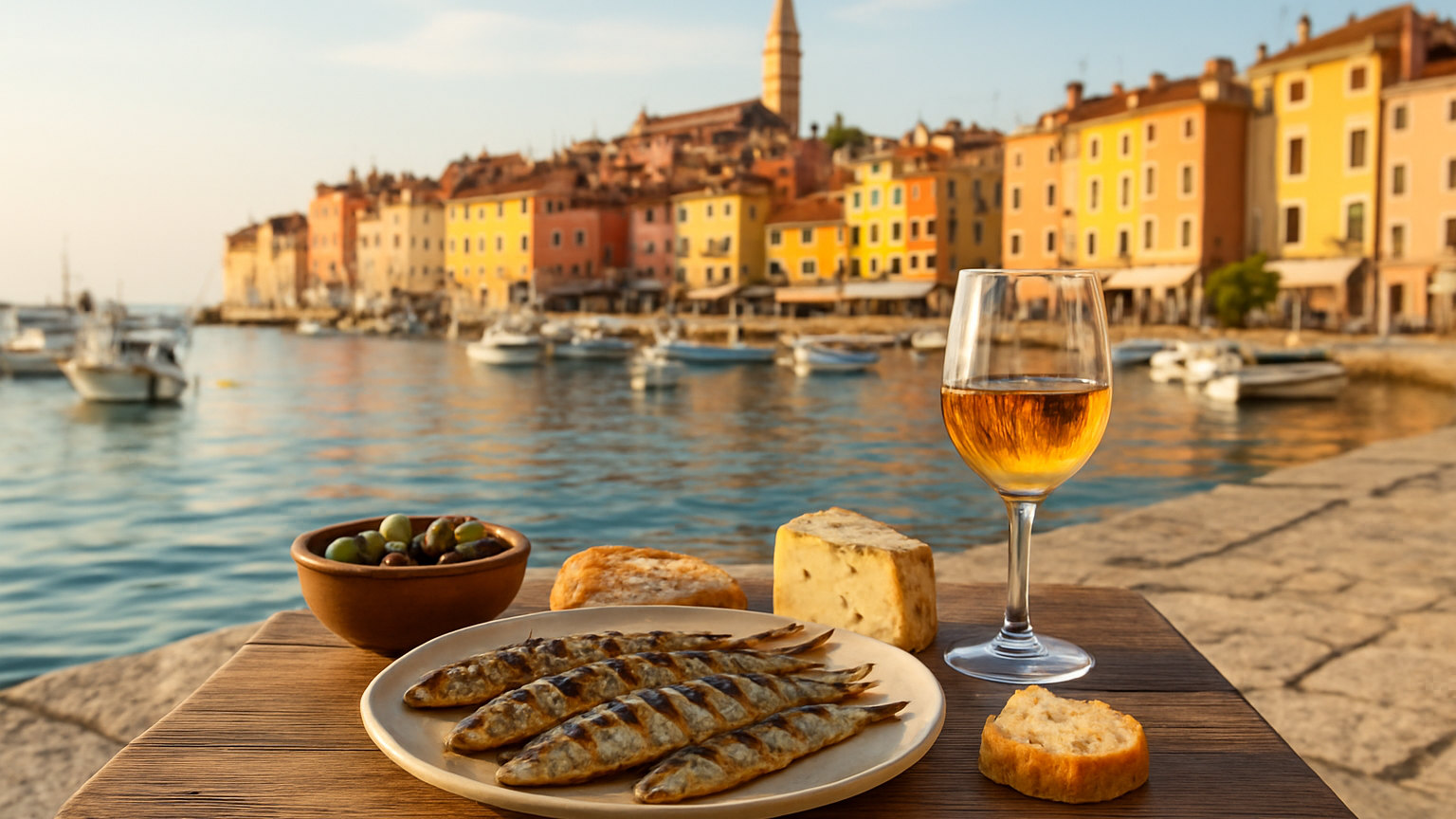
Rovinj sits on the western coast of Istria in northern Croatia, a peninsula of tall ochre houses rising to a church tower, closer to Venice in appearance and history than to anywhere in Dalmatia. It is the prettiest town on the Croatian coast and it costs substantially less than Dubrovnik or Hvar.
How long do you need?
Four to six nights. Rovinj itself needs two days and the surrounding region, meaning the hill towns, Pula and the Brijuni islands, fills several more. It works as a week in one place rather than a stop on a route.
What is there to see in the town?
The old town is the attraction: steep cobbled lanes running up to the church of St Euphemia, whose bell tower is modelled on the Campanile in Venice and can be climbed on wooden stairs for the view. The harbour, the Balbi arch and the small artists quarter along Grisia street. It takes a morning and rewards being walked again in the evening.
Where can you swim?
The Golden Cape park south of the town, a forested peninsula of rocky coves and pine, reached on foot or by bicycle in twenty minutes. Rock and pebble rather than sand, with exceptionally clear water. Swim shoes help. The Red Island, a short boat ride offshore, has more of the same with fewer people.
What is inland Istria like?
Hill towns on ridges above vineyards and oak woods, with a strong Italian influence. Motovun is the best known, with walls and a view over the Mirna valley. Groznjan is an artists village. Hum claims to be the smallest town in the world. This is truffle country, and the autumn white truffle season is a genuine draw.
What else is worth a day?
Pula, forty minutes south, which has one of the best preserved Roman amphitheatres anywhere, still used for concerts. The Brijuni islands, a national park that was Tito summer residence. Porec for the Euphrasian Basilica and its sixth-century mosaics, which are UNESCO listed.
How does it compare with Dalmatia?
Istria is cheaper, quieter, greener and considerably easier to reach from central Europe by road. Dalmatia has the island-hopping, the bigger name towns and the warmer sea. If your priority is a beautiful base, good food and lower prices, Istria wins clearly. If you want to island hop between Hvar and Korcula, it does not.
Where should you stay?
The old town for the setting, accepting stairs and no vehicle access. The streets just outside it for convenience and lower prices. The resort hotels south towards the Golden Cape for beaches and families. Agrotourism accommodation inland for the hill town version of the trip.
Where should you eat?
Istrian cooking is the best in Croatia and is essentially Italian with a Slavic accent: truffles, olive oil, fresh pasta, prosciutto and seafood. The region produces good olive oil and malvazija wine. Eat one street back from the harbour rather than on it.
When is the best time to visit?
June and September for swimming without the peak. May and October are excellent for the hill towns and the truffles. July and August are busy with Italian, Austrian and German visitors, though never as crowded as Dubrovnik.
How do you get there?
Pula airport is the closest, around forty minutes away, with a limited seasonal schedule. Trieste and Venice are both within two and a half hours by road and usually offer cheaper flights. There is no useful rail connection, so a hire car or a transfer is necessary, and a car is worth having anyway for the hill towns.
How long is the season?
Roughly May to early October for swimming, with the hill towns and truffle season extending usefully into November. Many coastal restaurants and hotels close between November and March.
Anyone weighing this up will also want Kotor: What to See in Montenegro Best Old Town, along with the rest of the Destinations section.
The short answer
Five nights in or beside the old town, with a car. Swim at the Golden Cape, climb the bell tower, spend a day in Motovun and Groznjan and a day in Pula. Choose Istria over Dalmatia if price and quiet matter more than island hopping.


