
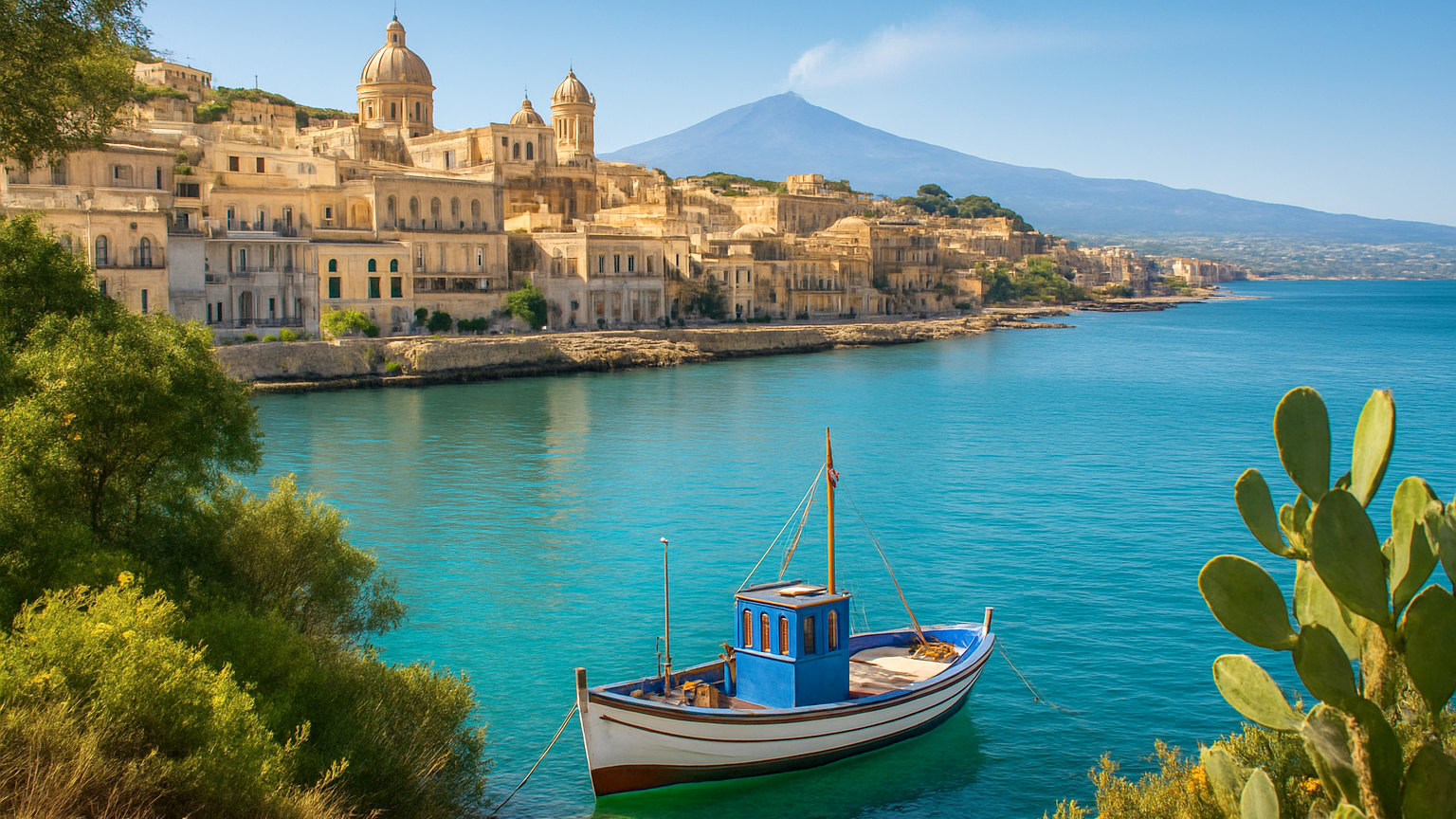
Sicily is the largest island in the Mediterranean and holds Greek temples better preserved than anything in Greece, an active volcano you can walk on, Norman cathedrals with Arab and Byzantine decoration, and three coastlines with different characters. A week covers a third of it, which is the first thing to accept when planning.
Where should a first trip go?
Split between the east and the southeast. Taormina or Catania as a base for Etna and the Ionian coast, then the baroque towns inland. A second trip can take Palermo and the west. Attempting the whole island in seven nights means three or four hours of driving on most days.
Is Etna worth a day?
It is the largest active volcano in Europe and is frequently erupting in a manageable way. A cable car and four-wheel-drive bus climb from Rifugio Sapienza on the south side, and guided walks reach the summit craters when conditions allow. The north side at Piano Provenzana is quieter. It is cold and windy at altitude in any season, which catches out visitors arriving from a beach.
What are the ancient sites?
The Valley of the Temples at Agrigento, a line of Doric temples along a ridge, of which the Temple of Concordia is among the best preserved Greek buildings anywhere. Segesta, a temple standing alone in open countryside. Selinunte, the largest archaeological park in Europe. The Greek theatre at Syracuse and the Roman mosaics at Villa Romana del Casale, which cover thousands of square metres.
What is the baroque southeast?
A group of towns rebuilt after the 1693 earthquake in a single, extravagant late baroque style, now UNESCO listed. Noto is the showpiece, with a honey-coloured main street. Ragusa Ibla, Modica and Scicli are the others, all built into steep valleys. Ortigia, the island old town of Syracuse, is the best base in the region.
Is Palermo worth time?
Three nights. It is chaotic, layered and the best street food city in Italy, with Norman-Arab architecture at the Palatine Chapel and the cathedral at Monreale outside the city, whose mosaics are among the finest in Europe. The markets at Ballaro and Capo are the reason to stay rather than visit.
Where are the beaches?
San Vito lo Capo in the northwest for the best sand. The Zingaro nature reserve nearby for coves reached on foot. Cefalu on the north coast for a beach beneath a medieval town. The southeast around Vendicari for sandy nature reserve beaches. Isola Bella at Taormina is famous, small and pebbly.
When is the best time to visit?
April, May, September and October. July and August are extremely hot inland, regularly passing thirty-five degrees, and the archaeological sites offer almost no shade. The sea stays swimmable into November. Winter is mild on the coast and Etna has a ski season.
Do you need a car?
Yes, outside the cities. Trains connect the coastal towns slowly and the interior barely at all. Driving is assertive rather than dangerous, and city centres have restricted traffic zones with automatic cameras, so park outside and walk in.
How long do you need?
Ten nights minimum for one half of the island, a fortnight to include both. Sicily is roughly the size of Wales with slower roads, and a week spent trying to cover it is a week spent driving.
How does Sicily compare with Sardinia?
Sardinia has far better beaches and clearer water. Sicily has vastly more history, better food and a volcano, and it is cheaper. Choose Sardinia for a beach fortnight and Sicily for a touring trip where swimming is a bonus rather than the point. Sicily also has far better flight connections from the UK.
Where to Visit in Madeira: Levadas, Peaks and Funchal goes into more detail on a closely related question, and the rest of our Destinations section covers the wider subject.
The short answer
Ten nights split between Ortigia, Taormina and Agrigento for the east and south, or a separate trip for Palermo and the west. Climb Etna, see the Valley of the Temples early in the day, and travel in May or October rather than August.


