
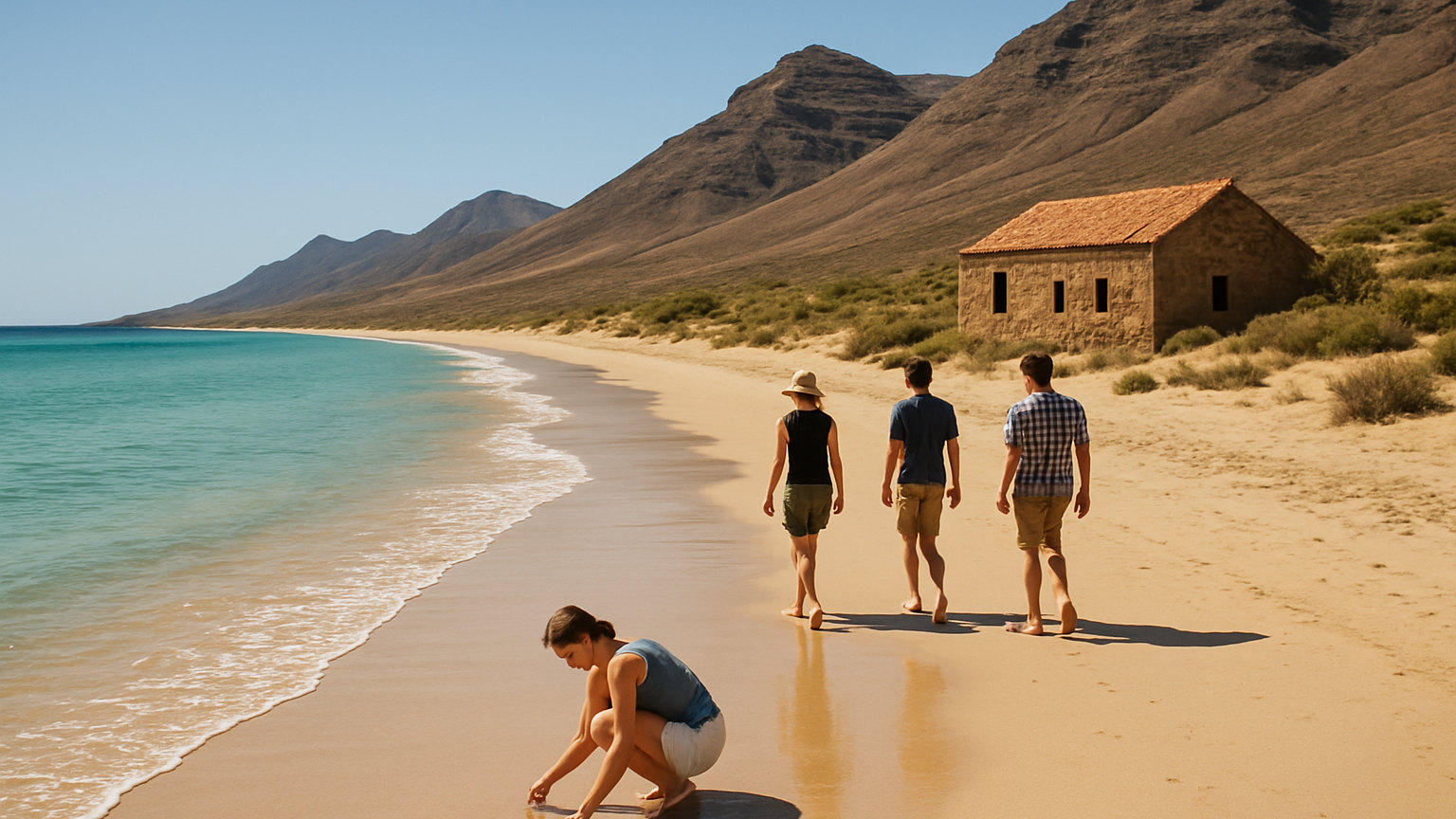
Fuerteventura is the second largest and the flattest of the Canary Islands, and it has by a clear margin the best beaches. It also has the least to do, almost no forest and very little in the way of towns. Whether that is a drawback or the entire point is the only question worth asking before booking.
Where should you stay?
Corralejo in the north for the dunes, the ferry to Lanzarote and the liveliest town. Costa Calma and Jandia in the south for the longest beaches and the calmest water. El Cotillo in the northwest for a smaller, quieter base with excellent lagoons. Caleta de Fuste in the middle for families and the easiest airport access.
Which beaches are the best?
Corralejo dunes, a national park of white sand running for several kilometres along the northeast coast, with water that is turquoise and often windy. Sotavento in the south, a vast lagoon beach that appears and drains with the tide and is a world-class windsurfing site. The Cotillo lagoons in the northwest, shallow and sheltered, which are the best for young children.
Is the wind a problem?
It is the defining feature of the island and the reason the windsurfing world championships are held here. On many beaches a windbreak is not optional, and on the exposed northern coast the sand moves. If you want still air for sunbathing, the sheltered bays at Costa Calma, Caleta de Fuste and the Cotillo lagoons are the ones to look for.
Is Lobos island worth a day?
Yes. It is a tiny uninhabited island fifteen minutes by boat from Corralejo, with a lagoon, a volcano you can climb in an hour and one restaurant that must be booked. Visitor numbers are capped and a free permit is required in advance, which is worth arranging before you travel.
What is there to see inland?
Betancuria, the former capital, a small white village in the hills that is the prettiest thing on the island. The Mirador Morro Velosa viewpoint above it. The windmills and the goat cheese farms, since the island produces majorero cheese which is protected and genuinely good. That is close to the complete list, and the interior is otherwise arid and empty.
When is the best time to visit?
Any month. Temperatures run between twenty and twenty-eight degrees year round and rainfall is very low, making it the driest of the main Canaries. The wind is strongest between May and September, which is also when the windsurfing and kitesurfing seasons peak.
Do you need a car?
If you want to see more than one beach, yes. The island is a hundred kilometres long, the roads are straight, empty and easy, and buses are infrequent between resorts. Hiring for three or four days covers everything worth reaching.
Who should choose Fuerteventura?
Anyone whose priority is sand, space and warmth in any month, along with windsurfers, kitesurfers and surfers. Anyone wanting nightlife, scenery, hiking or culture should take Tenerife, Gran Canaria or Lanzarote instead, all of which are a short flight or ferry away.
How long do you need?
A week is plenty and a fortnight is common among people who come for the beaches and the surfing. There is roughly two days of sightseeing on the island, so the length of stay depends entirely on how much beach time you want.
How does it compare with Lanzarote?
They are a forty-minute ferry apart and are quite different. Lanzarote has the volcanic landscape, the Manrique architecture and more to do; Fuerteventura has far better and emptier beaches and more wind. Combining the two in one trip is straightforward and is the best way to see both.
For the next step, see Where to Visit in Majorca Beyond the Beach Resorts, or browse the full Destinations section.
The short answer
A week based at Corralejo or Costa Calma with a car for a few days, the dunes, Sotavento and the Cotillo lagoons, and a permitted day on Lobos. Take a windbreak, and go for the beaches rather than the sightseeing.


