
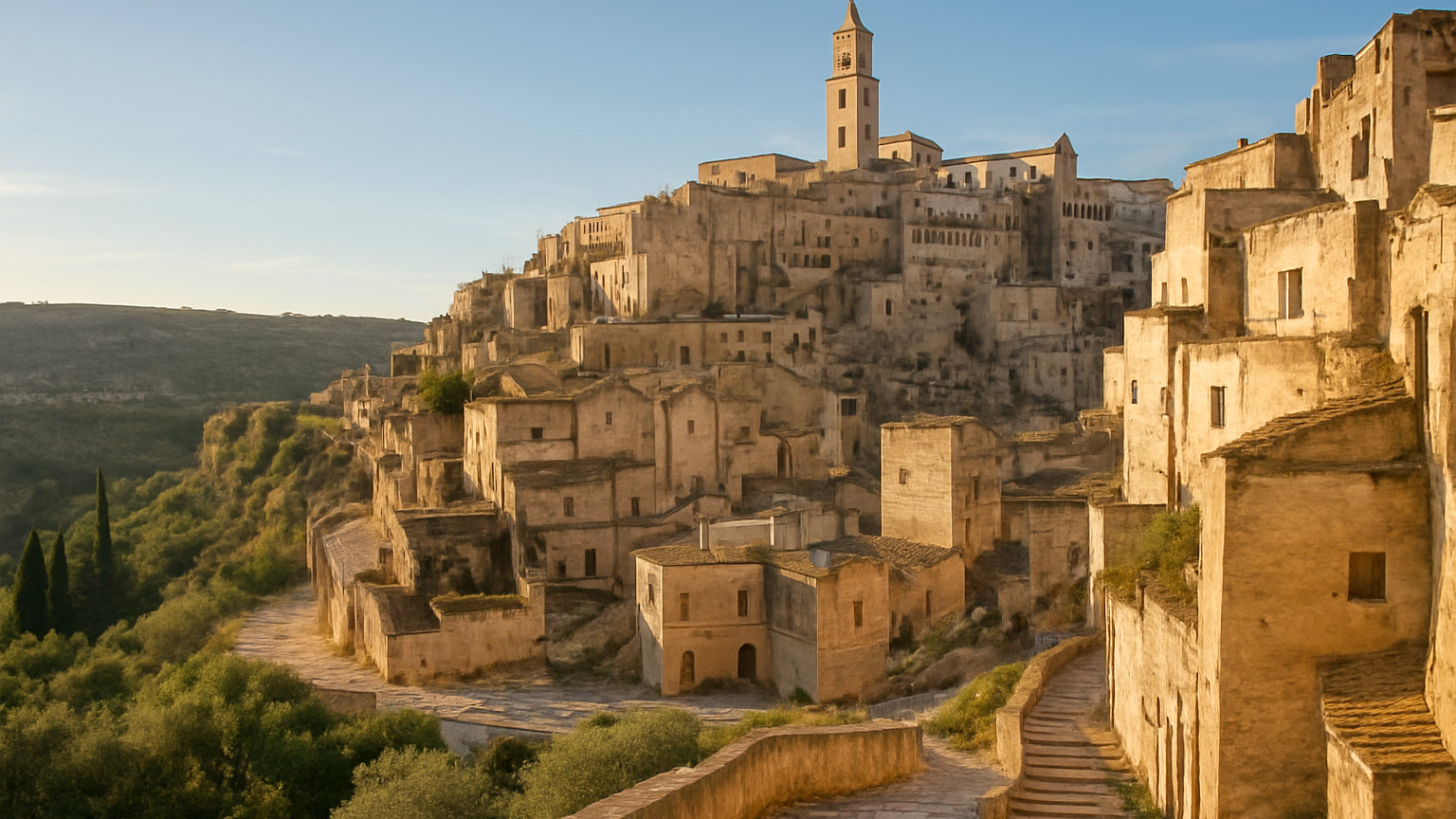
Matera sits in Basilicata, the arch of the Italian foot, and is built into a ravine of soft limestone. People have lived in caves cut into that rock for thousands of years, and until the 1950s families were still doing so in conditions the Italian government eventually declared a national disgrace and forcibly cleared. The same district is now UNESCO listed and full of hotels.
What makes it different?
Almost every other historic Italian town is built up from the ground. Matera is carved into it. The two cave districts, called the Sassi, are a vertical maze of dwellings, churches and cisterns hollowed out of the ravine wall, where one building roof is the street above it. Walking through it is unlike anywhere else in Europe, and it is why the town is regularly used as a stand-in for ancient Jerusalem in films.
How long do you need?
Two nights. One full day covers both Sassi districts, a rock church and the viewpoints. A second allows the ravine walk across to the caves on the far side, which is where the oldest settlements are.
What should you see?
Sasso Barisano and Sasso Caveoso, the two cave quarters. The Casa Grotta di Vico Solitario, a cave house preserved as it was when families lived in it with their animals, which takes fifteen minutes and explains the whole place. The rock churches, particularly Santa Maria de Idris and Santa Lucia alle Malve, with faded Byzantine frescoes. The Palombaro Lungo, an enormous underground cistern beneath the main square.
Where should you stay?
In a cave hotel in the Sassi, which is the point of coming and is more comfortable than it sounds, since the rooms hold an even temperature year round. Sasso Barisano has the greater concentration. Be aware that access involves steps and uneven stone, and that few of these hotels are reachable by car. The modern upper town is cheaper and flatter.
Where should you eat?
Basilicatan cooking is poor-country food done well: orecchiette with turnip tops, cruschi peppers dried and fried until they shatter, and bread from Matera itself, which has protected status and a distinctive tall shape. Prices are low by Italian standards. The restaurants on the main square are the most expensive and rarely the best.
How do you get there?
Bari is the nearest airport, around an hour away, with a regional railway and frequent buses. Naples is around four hours by coach. There is no mainline station in Matera itself, which is part of why it stayed obscure for so long. A car is useful for the wider region and a hindrance in the Sassi.
When is the best time to visit?
April, May, September and October. Summer in Basilicata is very hot and the stone holds the heat, which makes midday walking hard work. Winter is mild, quiet and atmospheric, with the Sassi often in mist. The feast of the Madonna della Bruna on 2 July is the biggest day of the local year.
How much should you budget?
Cheaper than almost anywhere comparable in Italy, though cave hotels command a premium for the novelty. Eating out, transport and entry fees are all low. The town has become considerably more expensive since it was European Capital of Culture in 2019, and remains good value.
What do people get wrong?
Wearing the wrong shoes. The Sassi are continuous worn limestone with steps everywhere and no flat route through, and smooth soles are genuinely hazardous in the wet. The second is treating it as a half-day stop from Bari, which gives you the view and none of the atmosphere, which belongs to the evening.
What is worth a day trip?
Altamura and Gravina in Puglia, both within an hour, for bread and a ravine town. Alberobello, around ninety minutes, for the trulli, the conical stone houses that are the other famous building style of the south. The Murgia park directly across the ravine from Matera holds the oldest cave settlements and rock churches of all, reached on foot.
Trieste: The Italian City That Feels Austrian answers a related question in more depth, and there is more of the same across our Destinations guides.
The short answer
Two nights in a cave hotel in Sasso Barisano, with proper shoes. See a preserved cave house early, walk both districts, cross the ravine on the second day, and go in spring or autumn rather than summer.


