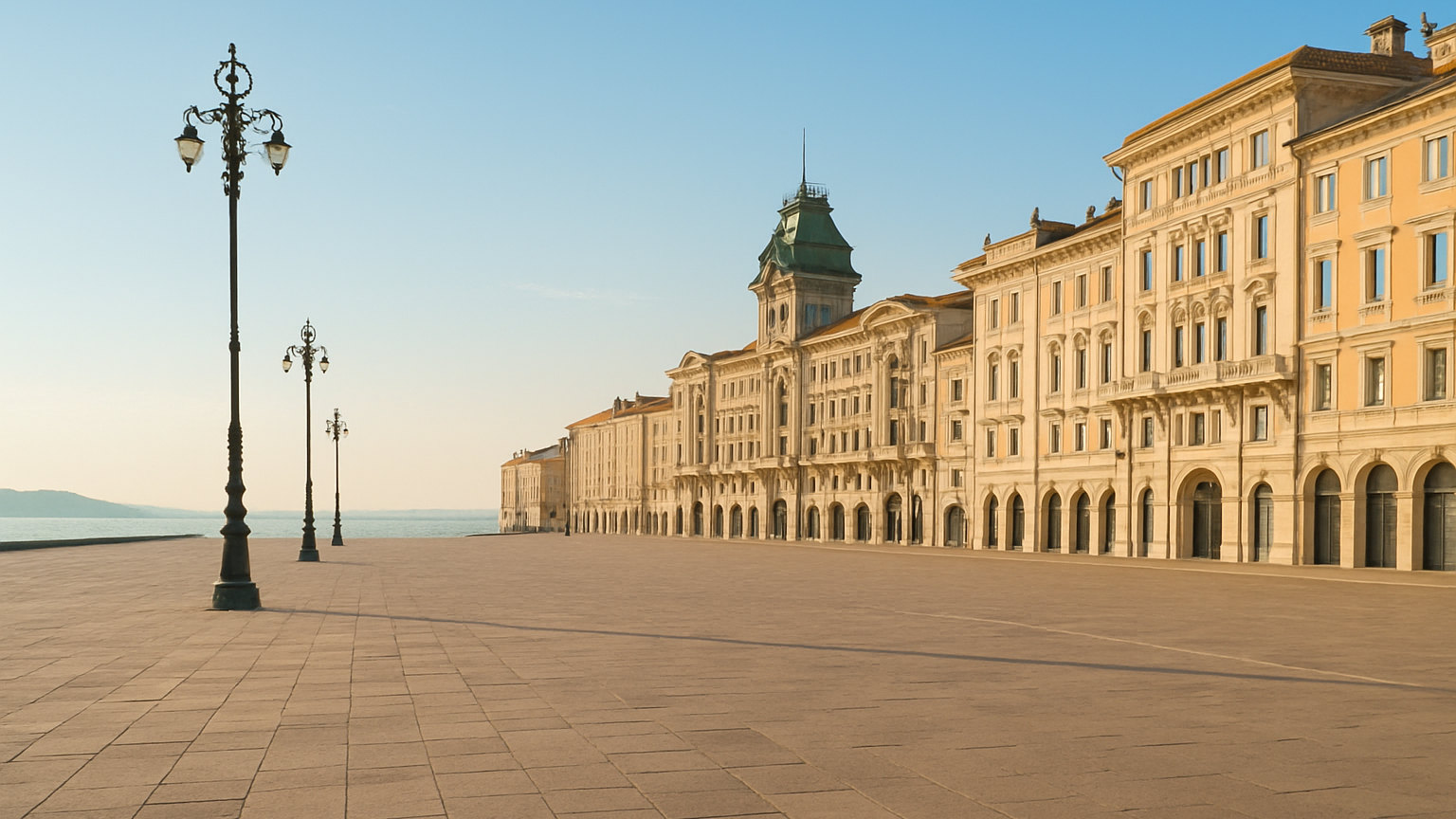
Trieste sits in the far northeast of Italy against the Slovenian border, and it does not look Italian. It was the main seaport of the Austro-Hungarian empire for centuries, and the centre is a grid of Habsburg neoclassical buildings facing the Adriatic. It receives a small fraction of the visitors that Venice two hours away does.
What makes it different?
The mixture. Italian, Austrian and Slovenian influences sit on top of each other, in the architecture, the food and the language. There is a Serbian Orthodox church on the canal, a Greek Orthodox one nearby, and one of the most important synagogues in Europe. The result is a city that feels like a border crossing rather than a destination, which is exactly its appeal.
How long do you need?
Two or three nights. The centre is compact and a day covers it. The second and third days go to Miramare, the Karst plateau above the city and the coastal walk, or to Slovenia and Croatia, both of which are within an hour.
What should you see?
Piazza Unita d Italia, the largest sea-facing square in Europe, which is the set piece and is best at dusk. The Canal Grande and the Borgo Teresiano quarter around it. San Giusto cathedral and castle on the hill. The Roman theatre in the middle of the modern streets. The Risiera di San Sabba, the only Nazi camp with a crematorium on Italian soil, now a memorial.
What are the coffee houses?
A Viennese tradition that stayed after the empire left. Trieste is Italy coffee capital, home to a major roasting industry, and its historic cafes are closer to Vienna than to Rome in style, with marble tables and long sittings. Caffe San Marco and Caffe Tommaseo are the two to know. The local ordering vocabulary is different from the rest of Italy, so a nero is an espresso and a capo in b is a macchiato in a glass.
What is worth a day trip?
Miramare Castle, a white nineteenth-century palace on a promontory with gardens running down to the sea, twenty minutes from the centre. The Grotta Gigante on the Karst, one of the largest accessible cave chambers in the world. The Rilke path along the cliffs at Duino. Ljubljana and Piran are both around ninety minutes away.
Where should you eat?
The food is the clearest evidence of the border. Goulash, sauerkraut and strudel appear alongside seafood and pasta. A buffet in Trieste is not a self-service counter but a traditional restaurant serving boiled pork, and Buffet da Pepi is the institution. The osmize in the hills above the city are farmhouses licensed to sell their own wine and cured meats for a few weeks a year.
When is the best time to visit?
May, June and September. The bora, a strong cold northeasterly, can blow through the city in winter at genuinely disruptive speeds, with ropes once strung along streets to hold on to. Summer is warm and the sea is swimmable from the concrete bathing platforms along the coast.
How much should you budget?
Noticeably cheaper than Venice, Verona or Milan, with accommodation in particular well below the northern Italian average because there is so little tourist demand. Eating is inexpensive, especially at the buffets.
What do people get wrong?
Expecting an Italian holiday town. Trieste has almost no beach in the conventional sense, no cathedral square in the Tuscan mould and very little of what visitors to Italy usually come for. Taken as a Central European port city that happens to be in Italy, it is superb; taken as a substitute for Verona or Bologna, it disappoints.
How long is the coast?
Short. The Italian strip here is only a few kilometres before Slovenia begins, and the swimming is from concrete platforms rather than sand. Barcola, the seafront promenade north of the centre, is where the city swims.
Anyone weighing this up will also want Lecce: The Baroque City in the Heel of Italy, along with the rest of the Destinations section.
The short answer
Three nights in the Borgo Teresiano. Piazza Unita at dusk, a morning at Miramare, a long sitting in a historic cafe, and a buffet lunch. Use it as a base for Slovenia if you have longer.