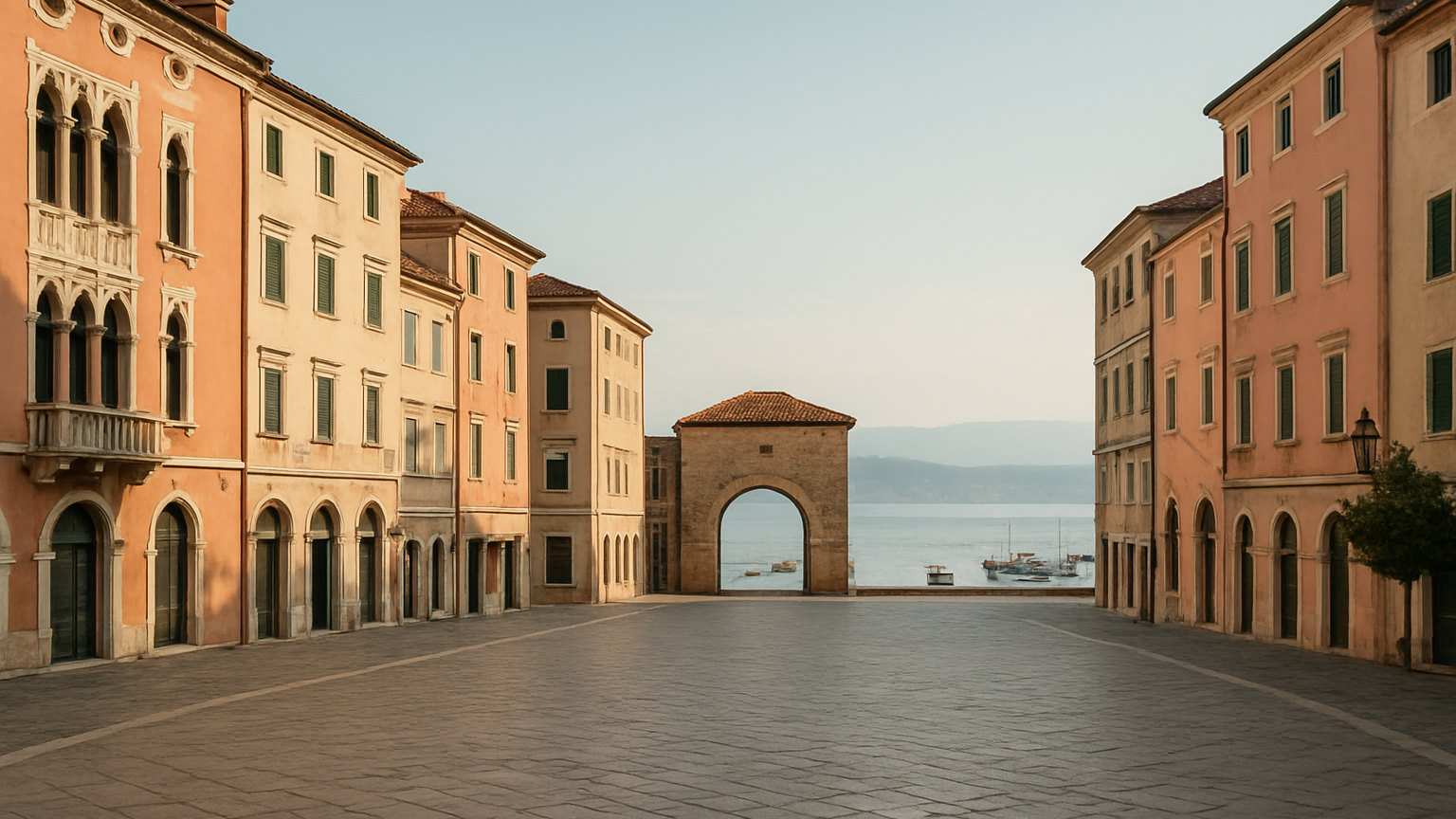
Slovenia has only around forty kilometres of coastline, squeezed between Italy and Croatia, and Piran is the one town on it worth planning a trip around. It sits on a narrow peninsula, was ruled by Venice for five centuries and looks it, and the old town is closed to traffic, which is a large part of why it has kept its character.
What makes it different?
It is a Venetian town on the Adriatic without the crowds of either Italy or Croatia. The main square is marble, the lanes behind it are narrow and steep, and the whole peninsula can be walked in twenty minutes. Because Slovenia is thought of as a mountain country, most visitors to the region never come here at all.
How long do you need?
Two nights. The town takes a morning, the walls and the salt pans a second day. It also works as a stop between Venice or Trieste and Croatia, or as a coastal end to a Slovenian trip that starts in the Alps.
What should you see?
Tartini Square, the oval marble main square, which was the inner harbour until it was filled in. The church of St George on the headland above, with a bell tower modelled on the Campanile in Venice, which can be climbed for the view along the coast to Italy and Croatia. The medieval town walls, a short steep walk up, which give the best panorama. The aquarium and the maritime museum.
Where can you swim?
From concrete platforms and rocks around the point rather than from sand, which is normal on this coast. Fiesa, a small pebble beach ten minutes walk east, is the nearest proper one. Portoroz next door is the modern resort with organised beaches, hotels and a casino, and is where most package visitors actually stay.
What are the salt pans?
The Secovlje salt pans south of Portoroz, where sea salt has been harvested by hand since the medieval period and still is. It is a nature park as well as a working site, with birdlife, walking paths and a small museum, and there is a spa nearby using the brine and mud. It is the most distinctive thing in the area.
Where should you stay and eat?
Inside the old town for the setting, bearing in mind that cars must be left in a garage outside and a shuttle bus runs in. Portoroz for hotels and beaches. The food is Istrian: seafood, truffles from inland, olive oil and malvazija wine. Eat one street back from the waterfront.
How do you get there?
Trieste is around an hour away and Ljubljana around two. Venice is three hours by road, and a seasonal catamaran runs between Venice, Piran and Rovinj. There is no railway. Buses connect along the coast and to Ljubljana, and a car is useful for the salt pans and Istria.
When is the best time to visit?
May, June and September. July and August bring Slovenian, Italian and Austrian holidaymakers and the small town fills quickly. Winter is quiet and mild and a good deal closes, though the old town is pleasant empty.
How much should you budget?
Mid-priced, cheaper than the Italian coast an hour away and broadly comparable with Istria in Croatia. Slovenia uses the euro. Accommodation in Portoroz is generally cheaper than in Piran itself.
What do people get wrong?
Driving into the old town, which is closed to traffic. Cars go into the Fornace garage outside and a free shuttle runs in every few minutes, and visitors who miss this spend a long time circling. The second is expecting a sandy beach, since the Slovenian coast is rock and concrete platform throughout.
The Faroe Islands: What to See and When to Go answers a related question in more depth, and there is more of the same across our Destinations guides.
The short answer
Two nights inside the old town, leaving the car in the garage. Climb the bell tower and walk the walls for the view, swim at Fiesa, spend a morning at the Secovlje salt pans, and combine it with Trieste or Istria rather than visiting alone.