
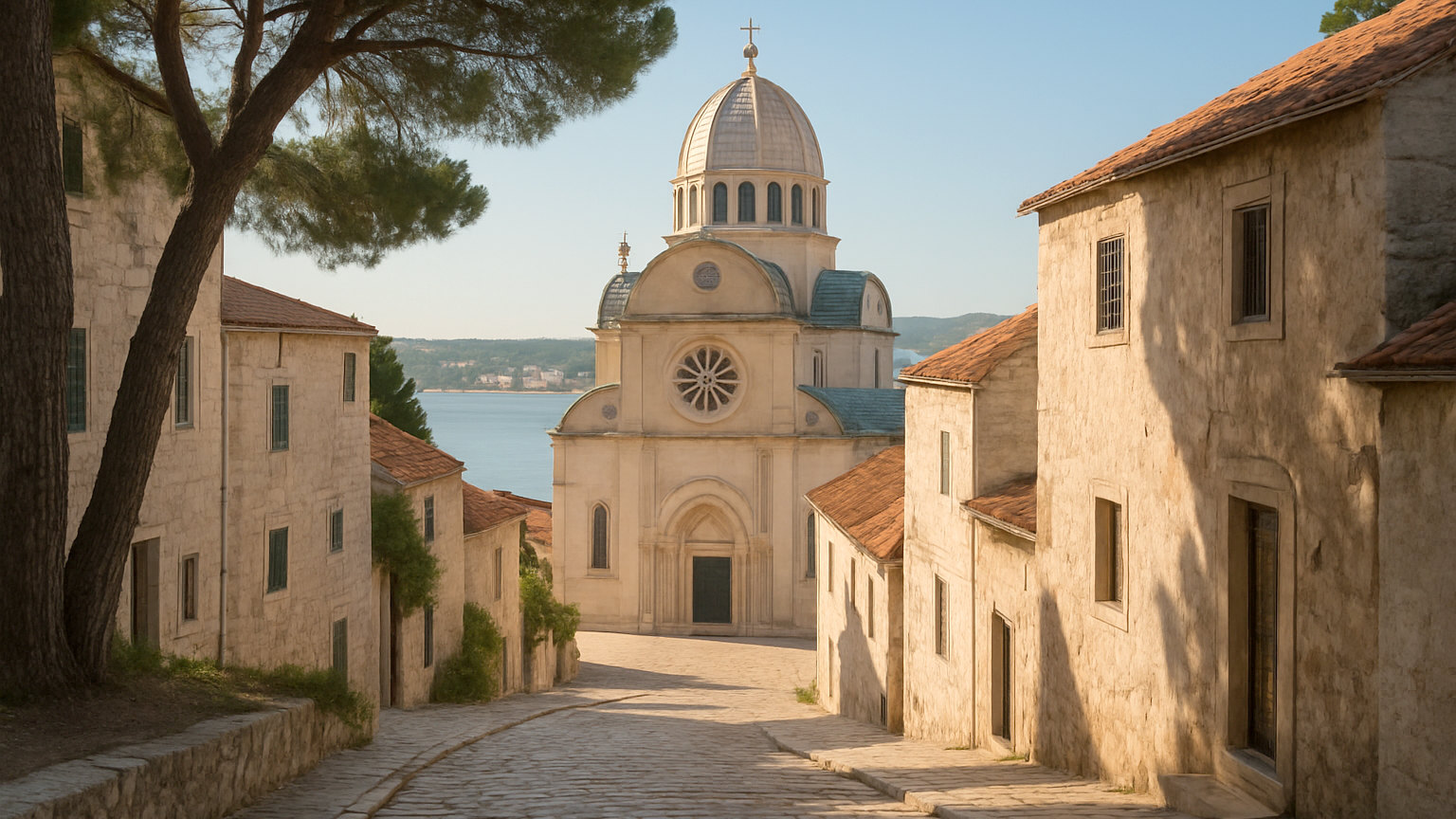
Sibenik sits on the Dalmatian coast between Zadar and Split, on a sheltered bay reached through a narrow channel. It has a UNESCO-listed cathedral, four fortresses and a stone old town climbing a hillside, and because the coaches run between its two better-known neighbours, it receives comparatively few visitors.
What makes it different?
It is the only major town on this coast that was founded by Croats rather than by Romans or Greeks, and the setting is unusual: the old town faces a lagoon rather than the open sea, entered through a gorge. It is also the closest base to Krka national park, which is the main reason many people end up here without intending to.
How long do you need?
Two or three nights, or a week using it as a base for Krka, the Kornati islands and the coast. The old town takes a morning and the fortresses an afternoon.
What should you see?
The Cathedral of St James, built entirely of stone without mortar or brick, with a frieze of seventy-one carved heads of ordinary fifteenth-century citizens around the outside. It is UNESCO listed and genuinely remarkable. St Michael fortress above it, restored as an open-air concert venue with a view over the islands. Barone fortress for the view inland. St Nicholas fortress on an island at the channel mouth, reached by boat.
Is Krka worth a day?
Yes, and it is the main draw. A national park of terraced waterfalls on the Krka river, less famous and much less crowded than Plitvice, with boardwalks through the falls at Skradinski Buk. Swimming beneath the main falls was banned some years ago, so check the current position rather than assuming. The park is reached by boat from Skradin or by road.
What about the islands?
The Kornati archipelago, a national park of around ninety mostly uninhabited limestone islands, is reached by day boat from Sibenik or Murter. It is stark, treeless and unlike the green islands further south. Zlarin and Prvic, small car-free islands, are a short local ferry away and make a good half day.
Where can you swim?
Not really in the town, where the water is a lagoon. Solaris, a resort complex a few kilometres west, has the nearest organised beaches. Primosten and Brodarica down the coast are better, and the islands are better still.
How do you get there?
Split airport is around forty-five minutes and Zadar around an hour, both with direct UK flights in season. Coaches run frequently along the coast. A car helps for Krka and the coastal villages and is unnecessary in the old town, which is stepped and pedestrianised.
When is the best time to visit?
June and September. July and August are hot and Krka in particular gets very busy in the middle of the day, so an early start there matters. The season is short and much closes between November and April.
How much should you budget?
Cheaper than Split, Dubrovnik or Hvar for accommodation and eating, which is the practical argument for basing here. Croatia uses the euro and coastal prices have risen sharply in recent years, so the saving relative to the famous towns is worth having.
What do people get wrong?
Treating it as a beach base, when the old town sits on a lagoon and the swimming is a drive away. The second is arriving at Krka in the middle of the day in July, when the boardwalks become slow-moving queues; the first entry of the morning is a completely different park.
Where should you stay?
The stepped old town for character, or Brodarica and Solaris just outside for a beach and easier parking. Skradin, at the edge of Krka, is a pleasant alternative base for anyone focused on the park.
Girona: The Catalan City an Hour From Barcelona is the natural next read, alongside the wider Destinations section.
The short answer
Three nights in the old town. See the cathedral and its carved heads, climb to St Michael fortress at sunset, take Krka early in the morning, and use Sibenik as a cheaper base than Split for the middle of the Dalmatian coast.


