
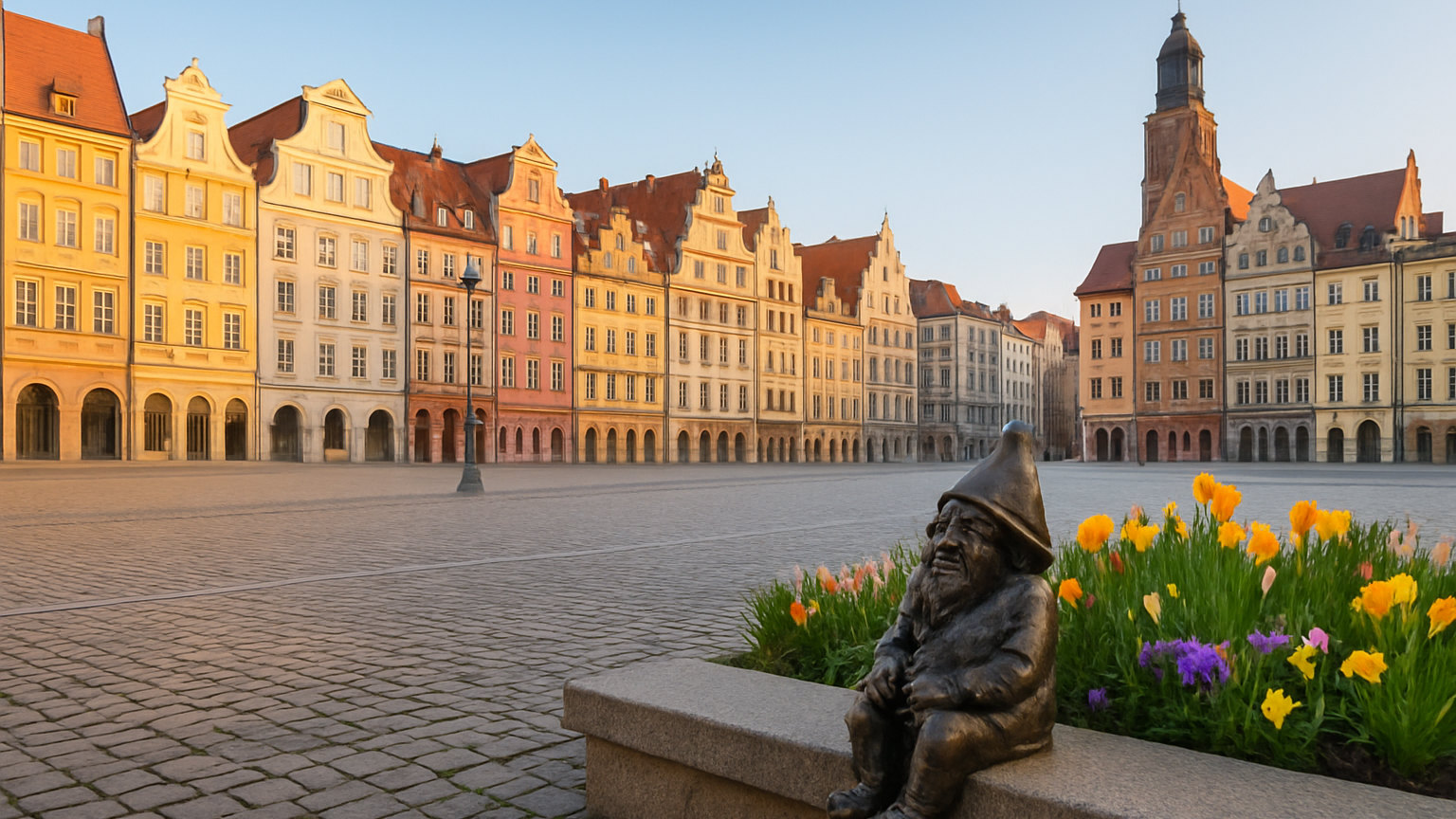
Wroclaw is the largest city in western Poland and was German Breslau until 1945, when the borders moved and the population was almost entirely exchanged. The centre was heavily damaged and rebuilt, and the result is a market square that rivals Krakow with roughly a third of the visitors.
What makes it different?
Two things. The city sits on the Oder and several tributaries and is spread across a dozen islands linked by more than a hundred bridges, which gives it a character no other Polish city has. And it is full of small bronze dwarfs, several hundred of them, set into pavements, climbing lampposts and sitting on window ledges. They began as a reference to an anti-communist protest movement of the 1980s and have become the city symbol.
How long do you need?
Two or three nights. The old town and the cathedral island take a day, and a second covers the Centennial Hall, the museums and the riverside. It combines well with Krakow, three hours away by train.
What should you see?
Rynek, the market square, with a Gothic town hall in the middle and coloured merchant houses around it. Ostrow Tumski, the cathedral island, which is the oldest part of the city and is still lit by gas lamps each evening by a lamplighter. The Panorama of the Battle of Raclawice, a huge nineteenth-century circular painting in a purpose-built rotunda. The Centennial Hall, a pioneering reinforced concrete dome from 1913 that is UNESCO listed.
How do the dwarfs work?
They are scattered across the whole city and each has a name and usually a joke attached, often relating to what is nearby. Maps and apps exist to find them and children in particular take the hunt seriously. The count keeps rising as businesses and residents commission new ones.
Where should you stay?
Around the Rynek for the setting, or Nadodrze and the streets north of the river for lower prices and a more local feel. Accommodation is cheaper than Krakow and considerably cheaper than Warsaw for the same standard.
Where should you eat and drink?
Polish cooking at low prices, with pierogi, zurek soup and bigos as the staples. The milk bars, subsidised canteens surviving from the communist period, serve a full meal for very little and are worth trying once. The square and the surrounding lanes have a dense concentration of bars, and the student population keeps them busy.
How do you get there?
Wroclaw has its own airport with direct UK flights. Krakow is around three hours by train, Warsaw around three and a half, and Berlin and Prague are both reachable by coach in four to five hours, which makes it a useful stop on a central European route.
When is the best time to visit?
May to September for warm weather and the river. December for the Christmas market, which fills the Rynek and is excellent and much cheaper than the German equivalents. January and February are cold, often below freezing, and very inexpensive.
How much should you budget?
Among the best value cities in the European Union. Poland uses the zloty, and declining the offer to be charged in pounds at a card terminal saves a few per cent. A restaurant meal with a drink costs less than half a western European equivalent.
What do people get wrong?
Treating it as a stopover between Berlin and Krakow and giving it one night. Wroclaw rewards two or three, and the evening on Ostrow Tumski when the gas lamps are lit by hand is the thing people remember. The second is missing the Panorama, which needs a timed ticket and sells out on busy days. Entry is included with several other city museums on the same ticket, which most visitors do not realise.
Anyone weighing this up will also want Plovdiv: Europe Oldest City and Its Roman Theatre, along with the rest of the Destinations section.
The short answer
Three nights near the Rynek. Watch the lamplighter on Ostrow Tumski at dusk, see the Panorama, hunt a few dwarfs, and pair it with Krakow rather than treating it as a standalone trip.


