
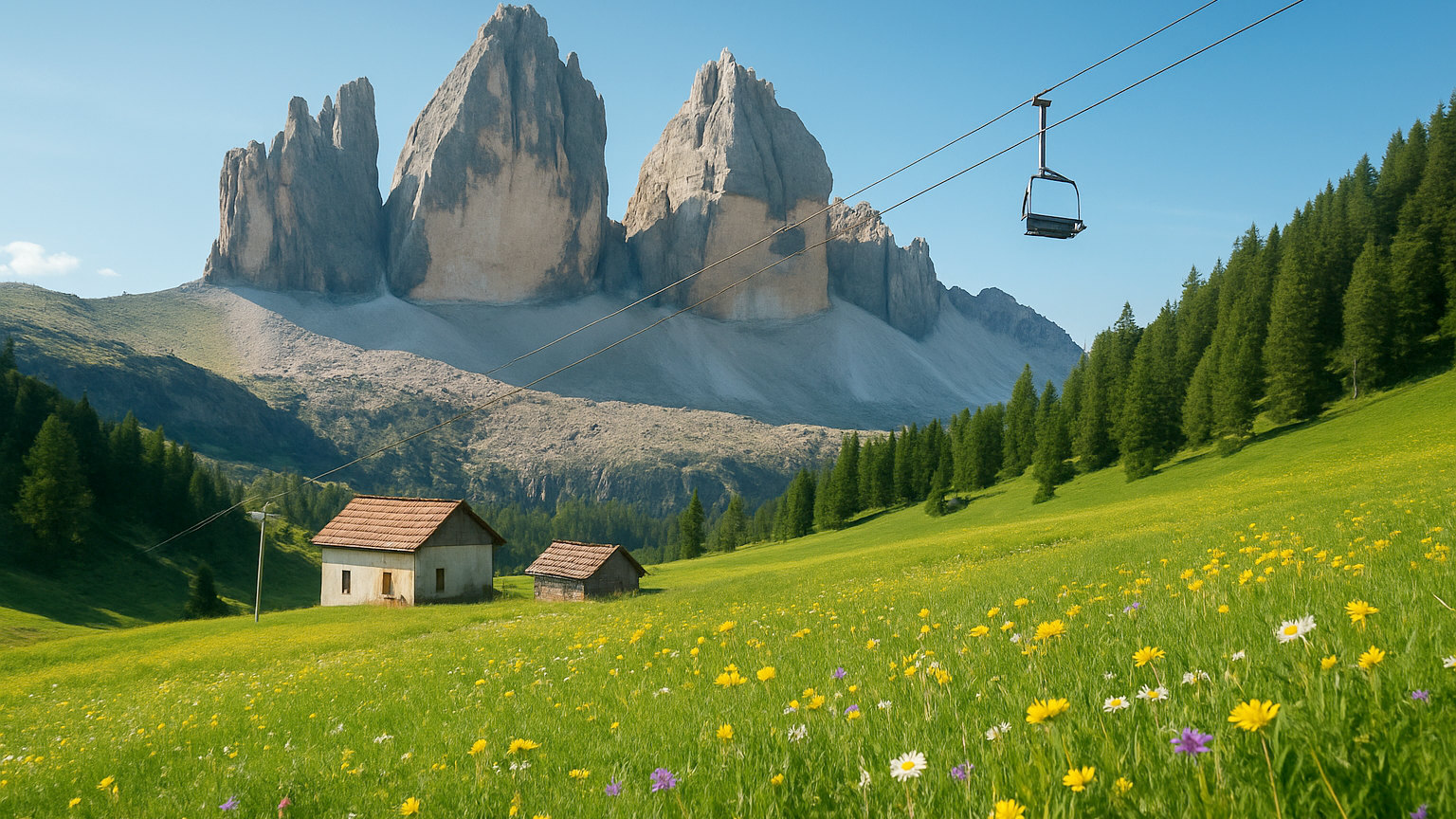
The Dolomites are a range of pale limestone towers in northeast Italy, UNESCO listed for their geology, and they look unlike any other European mountains: vertical grey walls rising abruptly from green meadow, turning pink at sunset in an effect the locals call enrosadira. The region was Austrian until 1919 and much of it still speaks German.
Which valley should you base in?
Val Gardena for the widest choice of lifts, accommodation and English-speaking infrastructure, with Ortisei as the main town. Alta Badia for a quieter and smarter option. Cortina d Ampezzo for the most famous resort, which is expensive and better known for skiing. Val di Funes for the classic church-and-peaks photograph. Val Pusteria in the north for access to the Tre Cime.
What should you see?
The Tre Cime di Lavaredo, three vertical towers circled by a well-made path of around ten kilometres, which is the single best day walk in the range. The Alpe di Siusi, the largest high alpine meadow in Europe, reached by cable car from Ortisei. Lago di Braies, a green lake below a cliff, beautiful and extremely photographed. The Seceda ridgeline, whose sawtooth profile is the other image everyone knows.
How do the lifts work?
They are the key to the whole region. In summer a network of cable cars and chairlifts carries walkers up to the high paths, turning what would be a punishing ascent into a half-hour ride. A Dolomiti Supersummer or valley lift pass pays for itself quickly. Check opening dates carefully, since most lifts run only from around mid-June to mid-September and again for the ski season.
What are the rifugi?
Mountain huts serving substantial food and offering beds, spread across the high ground and reachable on foot or by lift. They are considerably more comfortable than the word hut suggests, and eating lunch at one with a view over the peaks is central to the experience. Booking is essential for overnight stays, particularly on the Alta Via long-distance routes.
What about via ferrata?
Protected climbing routes using fixed cables and ladders, invented here during the First World War when the front ran through these mountains. They range from straightforward to serious, require a harness and lanyard, and guides are widely available. Several follow wartime tunnels through the rock.
When is the best time to visit?
Mid-June to mid-September for walking, with July and August the most reliable and the busiest. Late September is beautiful and many lifts have already closed. December to March for skiing, with the Sella Ronda circuit linking four valleys on one pass. May and November are the dead months when almost nothing runs.
Do you need a car?
It helps a great deal. Buses connect the valleys and run to a timetable built around residents, and the passes between valleys are slow. Note that access to Lago di Braies and the Tre Cime road is restricted in peak season, with shuttle buses or paid permits required.
How much should you budget?
Cheaper than Switzerland and more expensive than most of Italy. Lift passes and rifugio meals are the recurring costs. Half board in a valley guesthouse is common and good value.
What do people get wrong?
Arriving in late May or early June and finding the lifts shut and the high paths still under snow, which happens most years. The second is planning a walk without checking whether the lift back down is running that day, which turns a pleasant descent into a very long one.
How long do you need?
A week, based in one valley. The passes are slow and moving base mid-trip costs a day, so it is usually better to stay put and use the lifts.
It is worth reading alongside Lake Bled and Lake Bohinj: Which One to Choose, which takes a different angle, and the wider Destinations guides.
The short answer
A week in Val Gardena or Alta Badia in late June or September, with a car and a lift pass. Walk the Tre Cime loop, ride up to the Alpe di Siusi, eat lunch at a rifugio, and check the lift opening dates before you book.


