
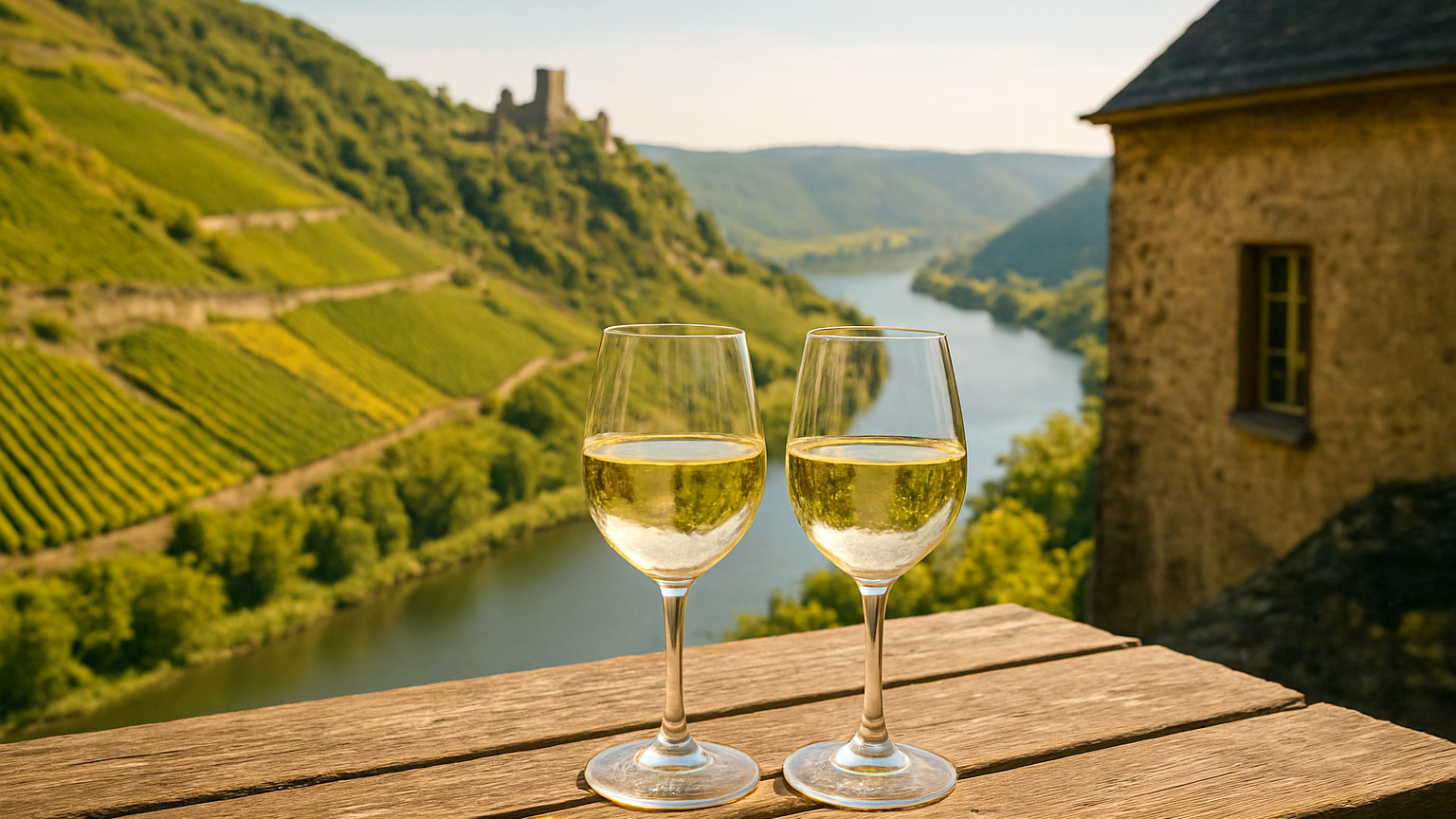
The Mosel winds between Trier and Koblenz in western Germany through a deep slate valley, looping back on itself so often that the road distance is roughly double the straight line. The south-facing slopes are the steepest vineyards in the world, some at over sixty degrees, worked by hand or with winches because no machine can hold the ground.
What do they make here?
Riesling, almost exclusively, and it is among the finest white wine in the world. The confusion abroad is over sweetness. Kabinett, Spatlese and Auslese refer to ripeness at harvest rather than sugar in the glass, and a wine labelled trocken is dry regardless of the ripeness level. Mosel Riesling is typically low in alcohol, high in acidity and ages remarkably well.
Where should you base?
Bernkastel-Kues, a half-timbered town with a market square and a ruined castle above, which is the most attractive base and the busiest. Traben-Trarbach for art nouveau architecture and a quieter feel. Cochem, further downstream, for the most photographed castle. Trier at the head of the valley is a proper city with the best Roman remains in Germany.
How do you visit the producers?
Informally. Most Mosel growers are small family estates with a tasting room, and walk-ins during working hours are generally fine, though a call ahead is better at harvest. Tastings are cheap or free with a purchase, and the wines are startlingly good value compared with equivalent quality from Burgundy or Alsace. The village wine festivals through summer are the easiest way to taste widely.
Is cycling the best way to see it?
Yes. The Mosel cycle path runs the length of the valley beside the water, almost entirely flat because it follows the river, and is one of the best and easiest long-distance routes in Europe. Bicycle hire and luggage transfer are widely available, and boats will carry bicycles, so you can ride one way and float back.
What about the castles?
Burg Eltz, set in a side valley rather than on the river, is among the finest medieval castles in Europe, never destroyed and still owned by the same family after more than thirty generations. Reichsburg Cochem is the dramatic silhouette above the town. Marksburg on the nearby Rhine is the only Rhine castle never destroyed.
When is the best time to visit?
May to October, with September and October best for the harvest and the vineyard colour. The wine festivals run through the summer in different villages. Winter is quiet, cold and damp, and many guesthouses close, though the Christmas market at Bernkastel is pleasant.
How much should you budget?
Inexpensive. German wine regions are considerably cheaper to visit than French ones, guesthouse accommodation in the villages is very reasonable, and the wine itself is among the best value in Europe at every quality level. Carry cash, as smaller estates and guesthouses often do not take cards.
What do people get wrong?
Assuming German Riesling is sweet. Most of it is now dry, and the labelling is the only barrier. The second is driving the valley road in a hurry, since it follows every loop of the river and takes far longer than the map suggests.
How long do you need?
Three or four nights, or a week if you are cycling the valley from Trier to Koblenz with luggage transfer. The villages are close together and the river loops mean short distances take longer than expected.
What should you eat?
Riesling-friendly food: Moselle trout, Saumagen, and the Zwiebelkuchen onion tart served with new wine in autumn. Trier has the best restaurant choice in the valley, along with the finest Roman remains in Germany, including an intact city gate and an imperial bath complex.
Tokaj: Hungary Sweet Wine Region goes into more detail on a closely related question, and the rest of our Destinations section covers the wider subject.
The short answer
Four nights based in Bernkastel-Kues or Traben-Trarbach, with bicycles. Taste a dry Kabinett against a Spatlese to understand the labels, visit Burg Eltz, ride one direction and take the boat back, and carry cash.


