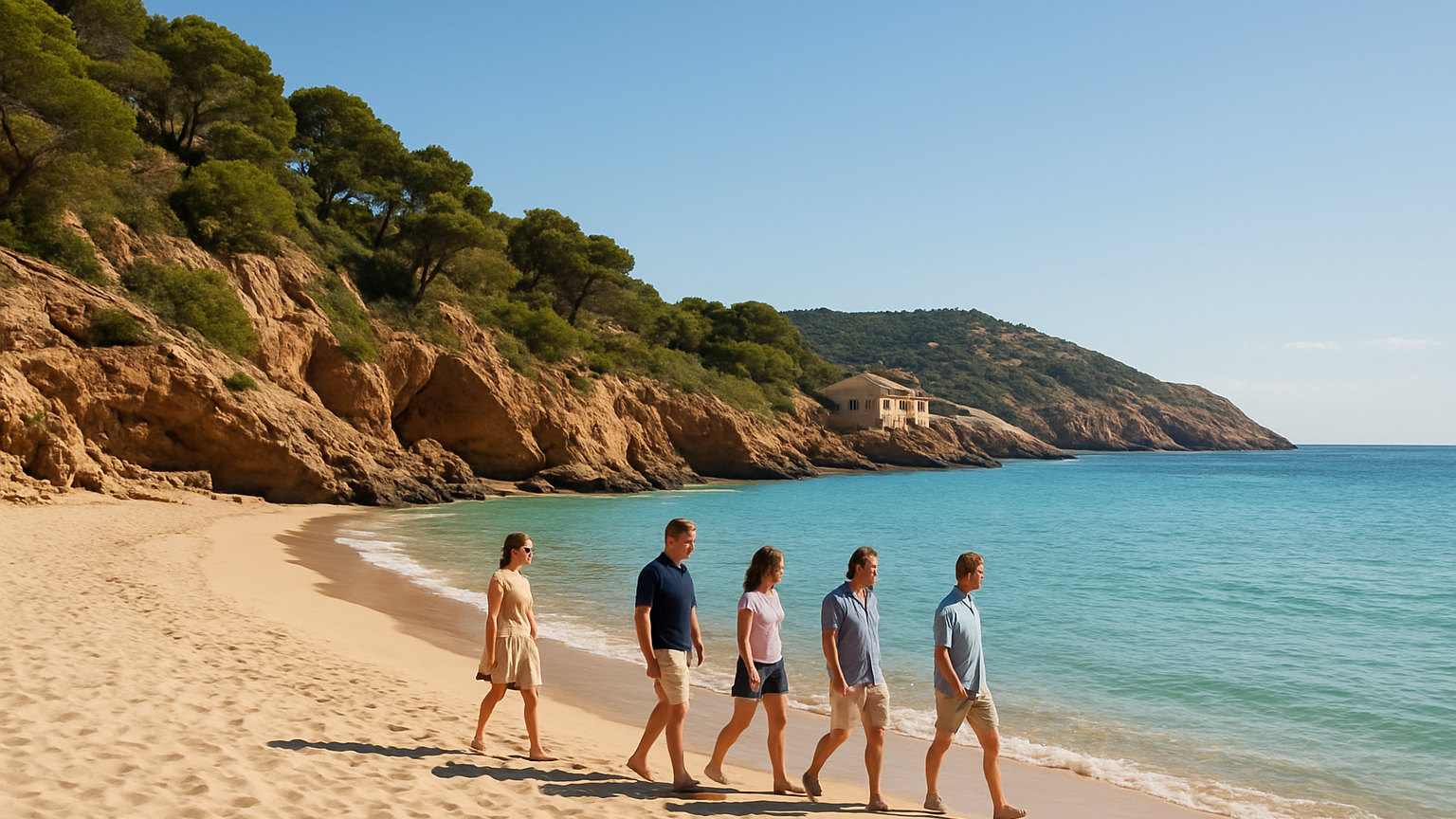
Photographs of turquoise water rarely show what is underfoot, and a surprising amount of European coastline is pebble, shingle or rock. For anyone travelling with children, or who simply wants to lie on a beach without a mat, this matters more than almost any other factor and is easy to establish in advance.
Which coasts are reliably sandy?
The Atlantic coasts, almost everywhere. The Algarve, the Costa de la Luz, the French Atlantic from Biarritz north, Brittany and the Portuguese west coast all have vast expanses of proper sand. The trade-off is cold water and wind.
In the Mediterranean, the Costa Blanca, the Costa Almeria, the eastern coast of Menorca and Mallorca, Sardinia, Puglia, the Ionian Greek islands, Crete, Rhodes and the southern Turkish coast are all substantially sandy.
Which coasts are mostly pebble or rock?
Croatia, which is the clearest case. Almost the entire Dalmatian and Istrian coast is pebble, shingle or concrete platform, with only a handful of sandy exceptions such as Zlatni Rat on Brac and parts of Lopar on Rab. Swim shoes are close to essential.
The French Riviera around Nice is smooth grey pebble, which catches out a great many first-time visitors. The Amalfi Coast is dark shingle. The Cinque Terre is largely rock with one sandy beach at Monterosso. Much of the Cyclades is coarse sand or pebble depending on the bay.
Why does it vary so much?
Sand comes from rivers carrying eroded material to the coast and from the breakdown of shells and coral. Coasts with mountains dropping straight into deep water and no significant rivers, which describes much of Croatia and the Riviera, have little sediment supply and therefore little sand. Flat coastal plains with rivers produce the long sandy beaches of the Atlantic and the Gulf of Valencia.
How do you check before booking?
Satellite view on a mapping app is the most reliable method: sand appears pale and uniform, pebble appears grey and textured. Photographs taken by visitors rather than the hotel show the truth. And the word beach in a listing means nothing, while spiaggia di ghiaia, plage de galets or a Croatian listing mentioning shljunak all mean pebbles.
Is pebble always worse?
No, and it has genuine advantages. The water is clearer because there is no sand to stir up, the beach stays cleaner, and nothing gets into bags, food or beds. Many people prefer pebble once they have a good mat or a sunbed. It is specifically bad with young children and with bare feet.
What should you take for a pebble beach?
Swim shoes, which are the single most useful item and cost very little. A proper foam or slatted mat rather than a towel. And a preference for beaches with sunbed hire, since a lounger removes the problem entirely.
Where is the best sand in Europe?
For a warm sea, the eastern Algarve, the Costa Blanca, Sardinia and the Ionian islands. For sheer scale, the French Atlantic coast and the Costa de la Luz. For a combination of white sand and clear water, Menorca, Sardinia and Formentera are the best in the Mediterranean.
What about black sand?
Volcanic coasts produce dark or black sand, which is genuine sand and behaves differently. Tenerife, Lanzarote, Santorini and parts of Sicily all have it. The main practical consequence is heat: black sand absorbs far more sun and becomes too hot to walk on barefoot by the middle of the day, which catches out visitors who have judged it by colour alone.
Is imported sand common?
More than people realise. Several well-known Mediterranean resorts truck sand onto naturally rocky beaches and renew it each season, including parts of Nice, Monaco and several Madeiran beaches. It is perfectly pleasant and it is worth knowing that a sandy beach in a rocky region is often a managed one.
For the next step, see Where Are the Best Snorkelling Beaches in Europe?, or browse the full Holidays section.
The short answer
Atlantic coasts have sand and cold water; the Mediterranean is mixed. Croatia, the Riviera and the Amalfi Coast are pebble. Check satellite view before booking, and pack swim shoes if the answer is anything other than sand.