
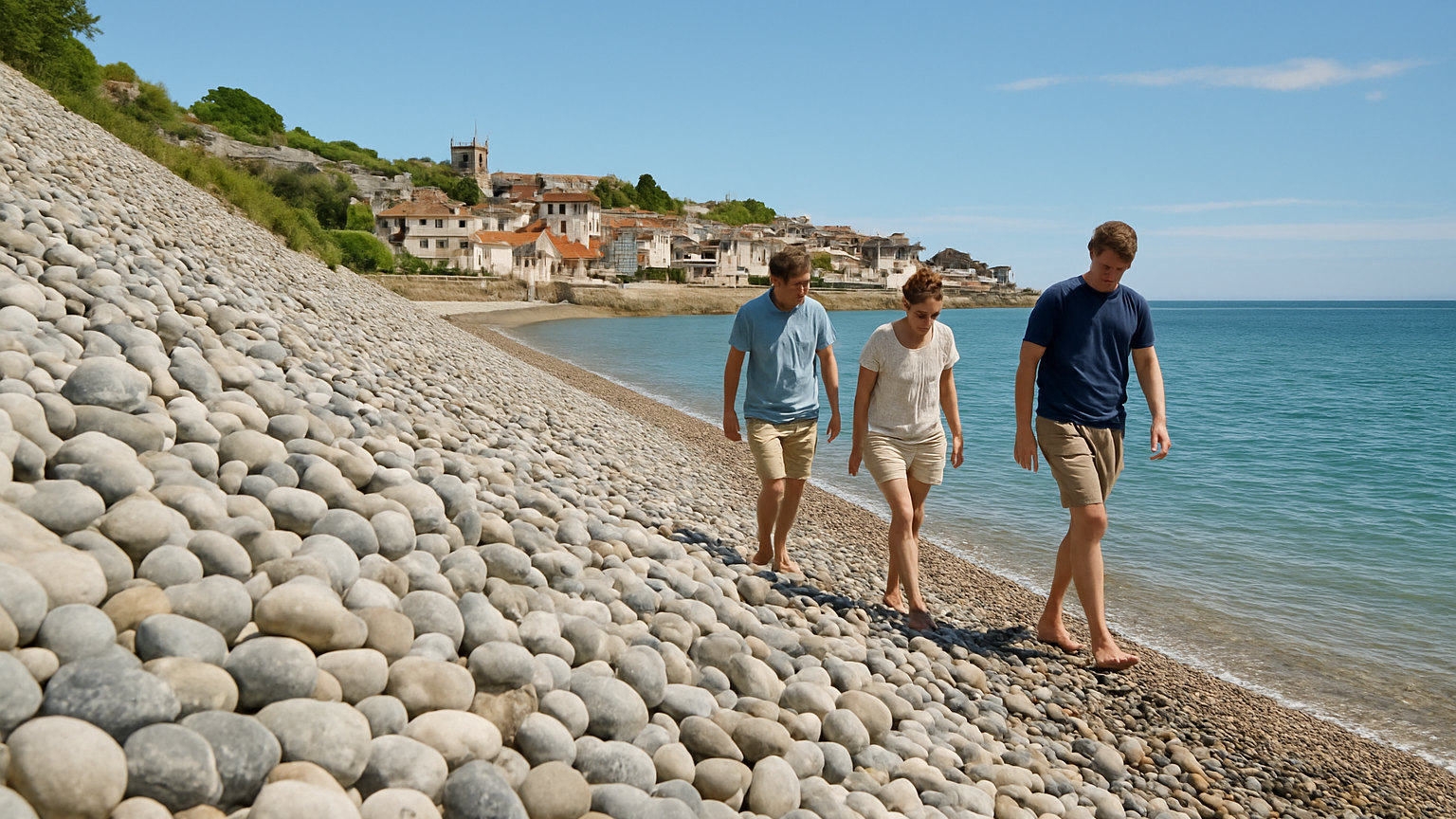
British visitors tend to treat pebble as a downgrade from sand, which misreads the trade. Pebble beaches have dramatically clearer water, no sand in the bag or the car, and far fewer people, and the discomfort is solved by a pair of shoes.
Why is the water clearer?
Because there is no fine sediment to stir up. A sandy beach clouds as soon as people enter the water; a pebble beach stays transparent regardless. Croatia, the Ligurian coast and much of Greece owe their famous clarity entirely to this.
What is the actual drawback?
Walking on them, lying on them and entering the water, all of which are uncomfortable without preparation. Large rounded pebbles are hard to walk on and awkward to lie on; small shingle is easier underfoot and gets into everything.
What solves it?
Swim shoes, which cost very little and transform a pebble coast entirely. They also protect against sea urchins, which live on rocky Mediterranean shores and are the commonest beach injury in Croatia, Greece and Italy.
A thick mat or a sunbed solves the lying-down problem.
Where are the pebble coasts?
Croatia almost entirely, the Ligurian and Amalfi coasts, Nice and much of the Cote d Azur, large parts of Greece, and the English south coast. Nice in particular is a famous beach that is entirely stones.
Are they better for swimming?
Frequently, since the water is clearer, deeper sooner and there is no sand disturbance. Snorkelling is far better on rocky and pebble shores, where fish and marine life have somewhere to live, which sandy beaches largely lack.
Do they get crowded?
Less, which is the underrated advantage. Families with small children gravitate to sand, so pebble beaches in the same area are consistently quieter in August, frequently by a large margin.
Do they suit children?
Less well for the obvious reasons, and older children frequently prefer them for the snorkelling and the rock pools. Swim shoes are essential rather than optional with children on any pebble or rocky shore.
What about rock platforms?
A related and very common Mediterranean form, particularly in Croatia, Malta and Greece, where concrete or natural rock platforms with ladders serve as the swimming area. These have the clearest water of all and require confidence in deep water.
Is the sea hotter or colder?
Usually a little cooler, since pebble beaches shelve more steeply into deeper water. Shallow sandy bays warm up considerably faster, which matters in May and October more than in August.
How do you sit comfortably?
A sunbed if the beach has them, otherwise a thick mat or a folding chair, which several European coastal supermarkets sell cheaply in season. A towel alone on large pebbles is genuinely uncomfortable after an hour.
Do they get hot?
Considerably, and more than sand. Dark stones absorb heat and become too hot to touch by midday, which is another argument for shoes. They also retain warmth into the evening, which makes a pebble beach pleasant after sunset.
Is it easier to stay clean?
Much. Nothing sticks, nothing gets into bags or cars, and you leave as clean as you arrived, which anyone who has driven a hire car home from a sandy beach will recognise as a real advantage.
Do they suit dogs?
Frequently better than sandy beaches, since many Mediterranean countries restrict dogs from managed sandy beaches in summer while unmanaged pebble shores have no such rules. Local restrictions vary by municipality and are usually signed at the access point.
Where are the best rock pools?
Pebble and rocky shores at low tide, which is the other advantage children eventually discover. The Atlantic coasts with a real tidal range have the best, since the Mediterranean barely exposes anything at low water.
For the next step, see What Do the Beach Flags Actually Mean?, or browse the full Inspiration section.
The short answer
Worth it for clearer water, better snorkelling and fewer people, with swim shoes as the one essential purchase. Croatia, Liguria, the Amalfi coast and much of Greece are pebble, and the shoes also protect against sea urchins on rocky shores.


