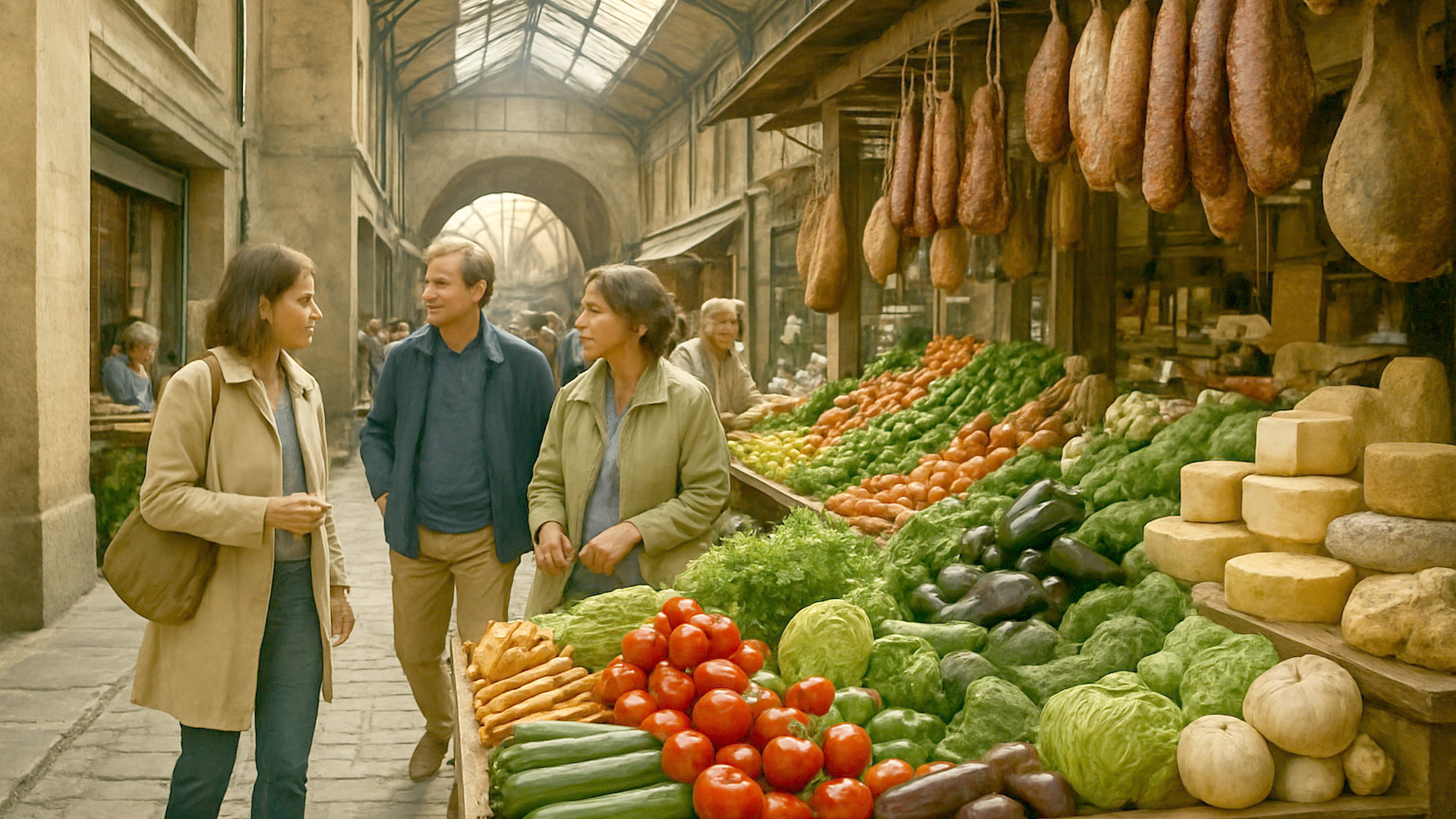
A market tells you what a place actually eats, in season, at local prices, in half an hour. Several of the famous ones have become attractions with a few stalls of produce among the souvenir stands, and the working markets nearby are usually better.
How do you tell a working market?
Whether people are buying ingredients rather than snacks. A working market has fishmongers, butchers, cheese and vegetable stalls serving residents with shopping bags. An attraction market has prepared food, tasting counters and high prices.
Both are enjoyable and only one tells you what the region eats.
Which are the great ones?
The Mercado de la Ribera in Bilbao and La Bretxa in San Sebastian. The Vucciria and Ballaro markets in Palermo. The Mercato di Porta Palazzo in Turin, the largest open-air market in Europe. The Naschmarkt in Vienna. The Athens central market.
What about the famous ones?
La Boqueria in Barcelona, the Mercado de San Miguel in Madrid and the Time Out market in Lisbon are all enjoyable and substantially aimed at visitors. The Boqueria has a genuine working section at the back, away from the entrance.
When should you go?
Early morning, when the produce is best and the traders are busy. Most European food markets wind down by early afternoon and many close entirely, particularly on Sundays and Mondays. Fish stalls sell out first.
Can you eat there?
At most of them, and frequently very well. Market bars and counters serve the traders early and the public later, and eating at the counter of a working market is among the best value meals in any European city.
How do you buy?
Take a ticket where there is a number system, common in Spanish and Italian markets. Ask for quantities in the local units rather than pointing at everything. Do not handle produce yourself at most stalls, since the trader selects it for you.
Should you haggle?
Not in western European food markets, where prices are fixed and marked. In Turkish and some Balkan markets there is more flexibility, particularly for larger quantities and non-food items.
What is worth buying?
Whatever is in season and local, which the volume on the stalls tells you. Cheese, cured meat, olives and preserved goods travel well. Fresh produce is for eating that day, which is what makes a rental with a kitchen worth having.
What about the covered halls?
A distinct nineteenth century tradition across Europe, with Budapest Great Market Hall, the Valencia Mercado Central and the Porto Bolhao among the finest buildings. Several are worth visiting for the architecture alone.
What about weekly markets?
The rural equivalent and frequently better than anything in a city. French, Italian and Spanish towns hold a weekly market on a fixed day, and it is the main event of the week. Worth planning a day around if you are staying nearby.
Which days do they run?
Daily in the large covered halls and on fixed days elsewhere, most commonly not Sundays and frequently not Mondays. Fish markets close on Mondays in much of the Mediterranean because the boats do not go out on Sunday, which is also why Monday is a poor day to order fish.
Are they good for a rainy day?
The covered halls, particularly, which are among the better indoor options in any European city and cost nothing to walk round.
What about flea and antique markets?
A separate tradition worth knowing about, since many European cities hold a weekly one alongside the food market. These run to different days and hours, frequently Sunday mornings, and the food stalls around them are usually excellent.
Which European Street Foods Are Worth Trying? is the natural next read, alongside the wider Inspiration section.
The short answer
Look for markets where people are buying ingredients rather than snacks, and go early since most wind down by lunchtime. Eat at the counter, which is excellent value, take a ticket where there is a number system, and plan a day around a rural weekly market if you can.