
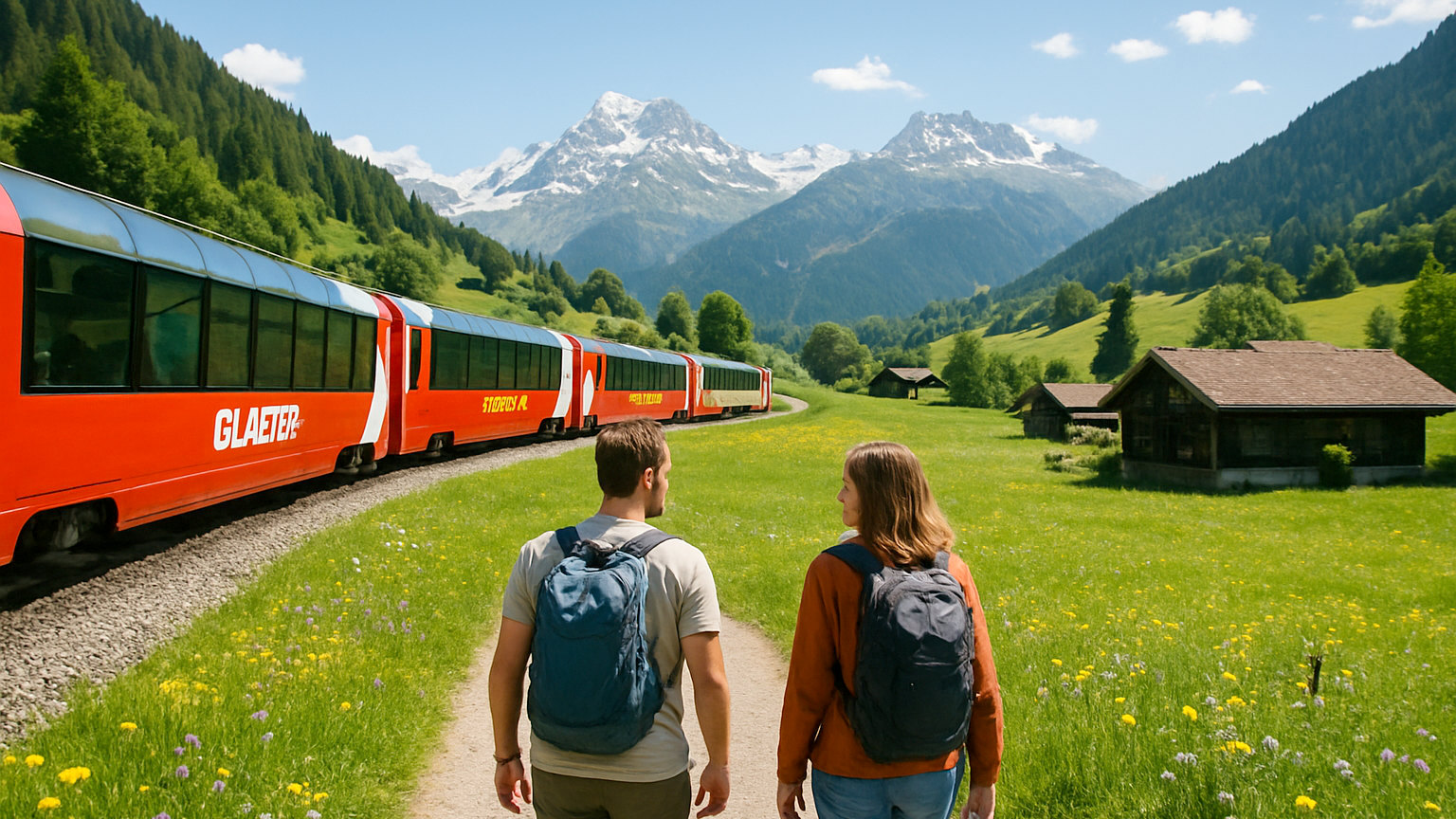
Europe has railways built through terrain that no sensible engineer would have chosen, and several are worth riding purely for what passes the window. Most are ordinary scheduled services that can be taken on a standard ticket.
Which are the great alpine routes?
The Bernina line from Chur to Tirano, crossing from Switzerland into Italy over a pass without a tunnel, which is a world heritage railway. The Glacier Express between Zermatt and St Moritz. The Golden Pass route. The Jungfrau railway to Europe highest station.
The Bernina can be taken as a regional service at a fraction of the panoramic train price.
What about Norway?
The Flam railway, one of the steepest adhesion railways in the world, dropping through a fjord valley in an hour. The Bergen line from Oslo across the mountain plateau, which is among the great European train rides and an ordinary service.
Which southern routes are worth it?
The Douro line from Porto, following the river into the wine country. The Circumetnea around Etna in Sicily. The Cinque Terre coastal line. The Bar to Belgrade line through Montenegro and Serbia, which crosses spectacular viaducts and is very cheap.
What about sleeper trains?
Expanded considerably in recent years, with the Austrian night network reaching much of central and western Europe. A sleeper saves a night of accommodation and arrives in a city centre, which for journeys of eight to twelve hours is a good arrangement.
Book early, since sleeper berths are limited and sell out.
Do you need a special ticket?
Rarely. Most scenic routes are scheduled services taking ordinary fares, and the branded panoramic trains charge a supplement for reserved seats and larger windows. The regional service on the same line is usually far cheaper and equally scenic.
What about rail passes?
Worth it for multi-country trips with frequent travel, and frequently not for a simple return, where advance tickets are cheaper. Reservations are compulsory and charged extra on many high-speed and scenic services even with a pass.
Which side should you sit?
Worth researching, since several routes have a decisively better side. On the Bernina heading south, on the Bergen line and on the Douro line the difference is substantial, and enthusiast forums usually specify it.
When should you go?
Alpine routes are best from June to October for clear passes, and spectacular in winter snow with shorter daylight. The Douro is best at harvest in September and October. Long daylight matters for any route taken for the view.
Are they good with children?
Very, since a train is an activity rather than a transfer. Tunnels, viaducts, mountains and a dining car hold attention far better than a car journey, and children travel cheaply or free across most European networks.
What about the cost?
Variable and frequently low. Regional services on scenic lines cost ordinary fares, and eastern European railways are extremely cheap. The branded panoramic trains and the Swiss network are at the other end, and Switzerland is expensive by any measure.
Are reservations compulsory?
On high-speed services in France, Spain and Italy, and on the branded scenic trains, yes. On regional services almost never, which is part of why taking the local train is simpler as well as cheaper.
What about the dining car?
A genuine part of the experience on several routes and disappearing on others. Swiss, Austrian and Nordic services keep proper restaurant cars, while many high-speed routes have reduced to a trolley. Worth checking if a long journey is meant to be the day rather than a transfer.
Are there heritage railways?
Plenty, and they are a separate pleasure. Steam and narrow gauge lines run across Britain, Germany, Austria, Switzerland and the Harz mountains, mostly seasonally and mostly short. They suit children particularly well and need no rail enthusiasm to enjoy.
If you are planning further, What Free Things Are Worth Doing? covers the next part of the decision, and there is more in our Inspiration guides.
The short answer
The Bernina, the Bergen line, the Flam railway and the Douro line are the best, and most can be taken as ordinary regional services rather than branded panoramic trains. Book sleepers early, check which side of the train has the view, and go when daylight is long.


