Resort bookings fail in predictable ways, and almost all of the information needed to avoid it is published or visible on a map. These are the checks worth making, roughly in the order of how much they affect the week.
What does the site look like?
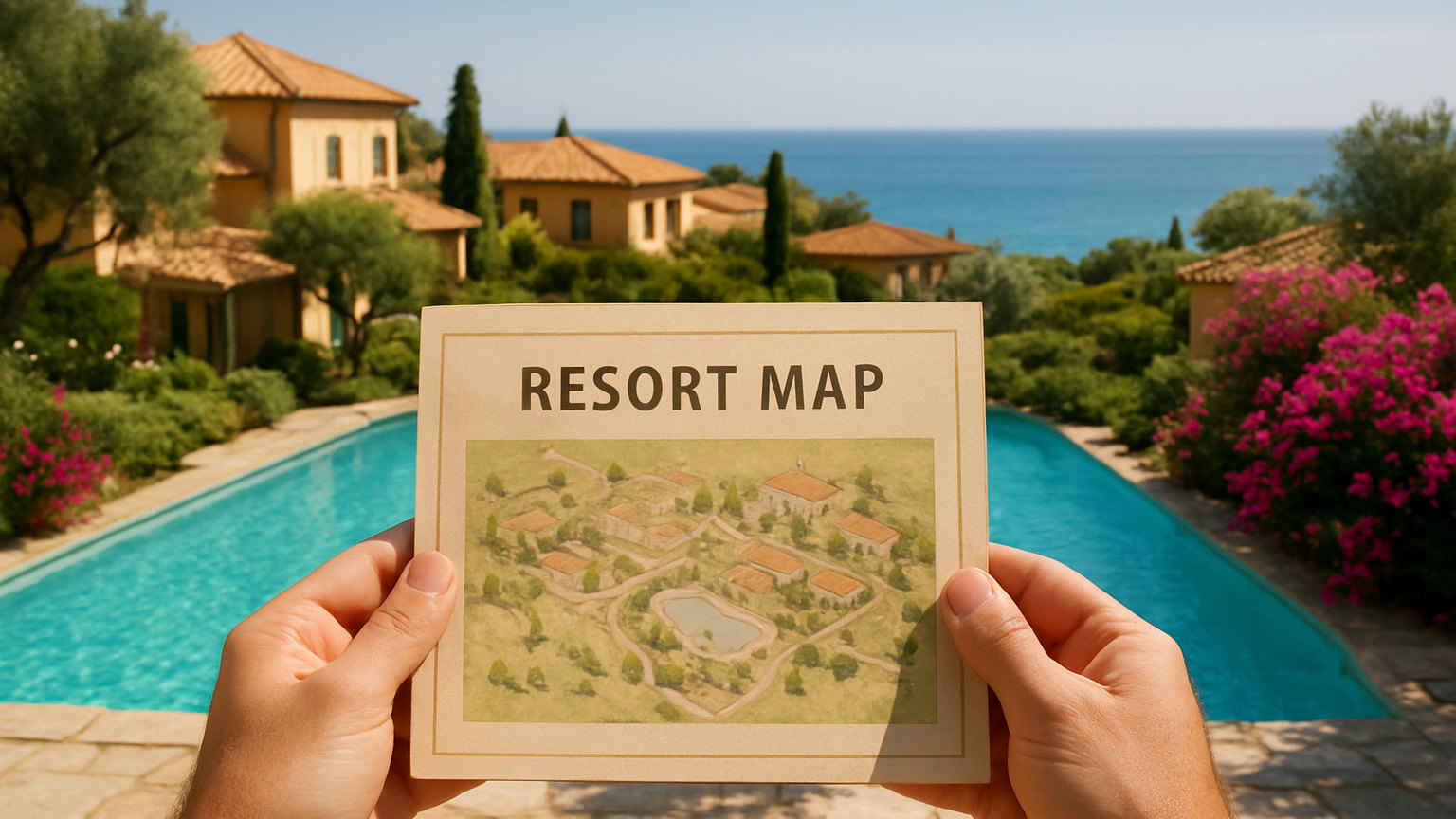
Satellite view first, which shows the footprint, the terrain, the position of the pools and restaurants, whether the beach adjoins and whether there is anything outside the perimeter. Five minutes here answers more than an hour of reading.
How far is everything?
The walk from the accommodation blocks to the pool, the restaurant and the beach, and whether the site is flat. Hillside resorts with steps are demanding with children, luggage or limited mobility, and a shuttle is worth confirming along with its hours.
Is the beach private?
Ask whether the resort owns or leases it, whether sunbeds and towels are included and whether all inclusive drinks are served there. A resort behind a public beach offers none of those, which is the commonest gap between expectation and reality.
Is the pool heated and does it have a shallow end?
Two questions and both decisive with children or outside high summer. Ask in which months it is heated and whether the children pool is heated separately, since it frequently is not.
Where is the entertainment?
Usually beside the main pool and audible until eleven. Ask which blocks are affected and request one away from it, in writing at booking. This is the single most common resort accommodation complaint and the easiest to avoid.
What is the real transfer time?
Check the driving time yourself and add roughly half again for a shared coach visiting several properties. Ask whether the return pick-up time is fixed, since it is frequently much earlier than the flight requires.
How do the restaurants work?
How many are included, how the a la carte booking system operates and when it opens, whether a supplement applies and what the dress code is. A resort with three a la carte restaurants that cannot be booked is worse than one with a good buffet.
What are the drink hours?
Ask when the last bar closes rather than when the main bar opens. Resorts range from continuous service to a bar closing at ten, and it shapes the evenings more than the brands do.
What is excluded?
Ask for the exclusions rather than the inclusions, which produces a more useful answer. Typically: tourist tax payable locally in cash, spa access, motorised watersports, premium spirits, a la carte supplements, safe hire and sometimes beach sunbeds.
What do recent reviews say?
Sorted by date, last six months, read for repeated specifics. Search for the words block, noise, building, refurbishment and closed. Guest photographs show the real room size and the state of the site far better than the marketing images.
Is the resort being refurbished?
The one thing only recent reviews reveal, and a genuine problem. Resorts refurbish in phases through the shoulder season and rarely disclose it at booking.
Is there a town within walking distance?
Worth establishing on the map even if you intend to stay on site, since it is what gives you an alternative if the resort disappoints. A property with a town at the gate is a different holiday from one on an empty stretch of coast with a taxi rank.
What about the room itself?
Check the stated size, whether there is a separate sleeping area if travelling with children, whether the balcony is usable and which way it faces. Guest photographs answer all four better than the listing images.
For the next step, see What Is the Difference Between a Hotel and a Resort?, or browse the full Hotels section.
The short answer
Start with satellite view for layout, terrain and beach access. Then ask whether the beach is private, whether the pool is heated with a shallow end, where the entertainment is, the real transfer time, the a la carte booking rules, the drink hours and what is excluded.